





Understanding the AC Evaporator Coil's Critical Function
The evaporator coil represents one of the most vital components in any air conditioning system, yet most property owners rarely consider its condition until system failure occurs. Located inside the indoor air handler or furnace cabinet, this coil serves as the heat absorption point where refrigerant transforms warm indoor air into the cool, comfortable air circulated throughout buildings. When an ac evaporator fails or operates inefficiently, the entire cooling system suffers measurable performance degradation. Visit acrepair for more.
Industry data reveals that evaporator coil issues account for approximately 35% of all residential air conditioner repair calls during peak cooling months. The coil consists of copper or aluminum tubing bent into multiple rows and surrounded by thin aluminum fins that maximize surface area for heat exchange. As warm air passes over these cold coils, the refrigerant inside absorbs thermal energy while simultaneously condensing moisture from the air—a dual function that makes proper evaporator operation essential for both temperature control and humidity management.
When technicians diagnose a/c unit problems, evaporator inspection ranks among the first diagnostic steps. A compromised coil cannot maintain proper refrigerant temperatures, forcing compressors to work harder and consuming 20-40% more electricity than properly functioning systems. This inefficiency translates directly to higher utility costs and accelerated wear on other system components.
Common Evaporator Coil Failures and Warning Signs
Property owners should monitor specific symptoms that indicate evaporator deterioration. Reduced cooling capacity represents the most obvious indicator—when your air conditioner runs continuously but fails to lower indoor temperatures to thermostat settings, the evaporator likely cannot absorb sufficient heat. Temperature differentials between supply and return air should measure 14-20 degrees Fahrenheit in properly functioning systems; measurements outside this range suggest coil issues.
Ice formation on refrigerant lines or visible frost on the coil itself signals serious problems. Contrary to intuition, ice accumulation indicates the evaporator is too cold, typically resulting from restricted airflow across the coil surface or low refrigerant charge. Once ice forms, it insulates the coil and prevents proper heat exchange, creating a destructive cycle that can damage compressors if left unaddressed.
Water leaks around the indoor air handler frequently trace back to evaporator problems. These coils normally produce condensate as they remove humidity from air, but blocked drain lines or corroded drain pans cause water to overflow into living spaces. Studies show that condensate-related water damage claims cost property insurance carriers over $2.5 billion annually, with average repair costs exceeding $7,000 per incident when structural damage occurs.
Unusual odors emanating from supply vents often indicate biological growth on evaporator surfaces. The consistently moist, dark environment inside air handlers creates ideal conditions for mold and bacteria colonization. Research from the Environmental Protection Agency confirms that contaminated HVAC systems can degrade indoor air quality sufficiently to trigger respiratory symptoms in sensitive occupants.
The Science Behind Evaporator Coil Deterioration
Understanding why evaporator coils fail helps property owners make informed decisions about air conditioning maintenance schedules and replacement timing. Corrosion represents the primary failure mode, particularly in coastal regions where salt-laden air accelerates metal degradation. Formicary corrosion—caused by formic acid and other organic compounds in indoor air—creates ant-nest patterns of pinhole leaks in copper tubing. This invisible damage often occurs years before refrigerant loss becomes noticeable.
The aluminum fins surrounding refrigerant tubing corrode through galvanic action when dissimilar metals contact each other in the presence of moisture. Manufacturers apply protective coatings to delay this process, but these coatings inevitably break down after 8-12 years of operation in typical residential environments. Once fin corrosion begins, the affected areas conduct heat poorly and restrict airflow, reducing system capacity by 5-15% even when refrigerant charge remains correct.
Mechanical damage from improper maintenance ranks as another major cause of premature evaporator failure. Technicians who use excessive pressure during coil cleaning can bend delicate fins or puncture refrigerant tubing. Industry standards specify maximum cleaning pressures of 400 PSI for residential systems, yet pressure washers often exceed 2,000 PSI. A single cleaning session with inappropriate equipment can inflict damage requiring complete coil replacement.
Refrigerant leaks develop gradually as vibration, thermal expansion cycles, and chemical exposure fatigue metal components. The average residential system loses 2-3% of its refrigerant charge annually through normal permeation, but pinhole leaks or failed joints accelerate this loss dramatically. When refrigerant levels drop below 85% of design charge, evaporator temperature falls below the freezing point of condensate, initiating the ice formation cycle described earlier.
Professional Diagnostic Procedures for Evaporator Assessment
Qualified technicians responding to emergency air conditioning repair near me requests follow systematic diagnostic protocols to differentiate evaporator issues from other system failures. Visual inspection begins the process, requiring removal of access panels to examine coil surfaces for corrosion, biological growth, damaged fins, or ice accumulation. Technicians document fin condition using percentage estimates—coils with greater than 30% fin damage typically warrant replacement rather than cleaning.
Temperature and pressure measurements provide objective performance data. Technicians measure refrigerant pressure at both the evaporator inlet and outlet, comparing readings against manufacturer specifications for ambient conditions. Superheat calculations—the temperature difference between evaporator outlet temperature and refrigerant saturation temperature at measured pressure—reveal whether the coil receives appropriate refrigerant flow. Correct superheat typically ranges from 8-12 degrees Fahrenheit; higher values indicate underfeeding while lower values suggest overcharging or restricted airflow.
Airflow measurement across the evaporator determines whether the coil can process sufficient air volume for rated capacity. Residential systems require 400 cubic feet per minute per ton of cooling capacity. Technicians use anemometers or manometers to measure actual airflow, with readings below 350 CFM per ton indicating restrictions that reduce capacity and risk ice formation. Dirty filters account for 60% of restricted airflow cases, but crushed ductwork, closed registers, or clogged coils cause the remainder.
Leak detection employs multiple technologies depending on refrigerant type and leak severity. Electronic leak detectors sense refrigerant molecules in concentrations as low as 0.1 ounces per year, while ultraviolet dyes injected into the refrigerant circuit glow under blacklight to pinpoint exact leak locations. For suspected evaporator leaks, technicians often pressurize the system with nitrogen and submerge accessible coil sections in water to observe bubble formation. This destructive testing requires refrigerant recovery and system evacuation but provides definitive leak confirmation.
Cleaning vs. Repair vs. Replacement Decision Framework
Service providers must guide property owners through cost-benefit analysis when evaporator problems surface. Cleaning represents the least invasive intervention and applies when coils accumulate dirt, dust, or biological contamination without structural damage. Professional cleaning costs $150-$400 for residential systems and restores 95% of original efficiency when performed on structurally sound coils. The procedure involves applying specialized coil cleaning solutions that break down organic buildup without corroding metal surfaces, followed by controlled rinsing and sanitizing treatments.
Annual air conditioning maintenance should include evaporator inspection and cleaning to prevent efficiency losses. Data from the Air Conditioning Contractors of America shows that regularly maintained systems consume 15-20% less energy than neglected equipment and experience 40% fewer emergency breakdowns. The cost of preventive coil cleaning represents roughly one-tenth the expense of emergency repair calls and replacement parts.
Repair becomes viable when evaporator leaks occur in accessible locations and the coil otherwise remains in serviceable condition. Technicians can braze small leaks in exposed refrigerant lines, though repairs to the coil core itself prove more challenging. Leak repair costs range from $225-$650 depending on leak location and refrigerant type. However, repair extends coil life by only 2-4 years on average when corrosion has initiated, making it a temporary solution for aging systems.
Replacement constitutes the appropriate solution when coils exhibit widespread corrosion, multiple leaks, severe fin damage, or age exceeding 12 years. New evaporator coil installation costs between $600-$2,000 for equipment, with labor adding $400-$1,200 depending on system accessibility and refrigerant handling requirements. Despite higher upfront costs, replacement eliminates recurring repair expenses and restores full system efficiency. Energy savings from new coils typically offset installation costs within 3-5 years in commercial applications running extended hours.
The decision between repair and replacement must account for system age and outdoor a/c unit condition. Installing a new evaporator coil on a system with a 15-year-old compressor rarely makes economic sense, as compressor failure probability increases dramatically after year 12. Matched system replacement—installing new indoor and outdoor components simultaneously—costs 15-25% less than sequential replacements and ensures optimal efficiency through properly matched refrigerant circuits.
Installation Considerations for Evaporator Replacement
Proper evaporator installation requires specialized knowledge beyond basic mechanical skills. Technicians must select replacement coils matching the outdoor unit's capacity, refrigerant type, and metering device requirements. Mismatched components reduce efficiency by 10-30% and may violate manufacturer warranties. Modern systems using R-410A refrigerant operate at pressures 50% higher than legacy R-22 equipment, requiring coils rated for elevated pressure service.
Airflow configuration affects coil selection, as systems use either upflow, downflow, or horizontal air handler orientations. Installing an incorrectly oriented coil causes condensate drainage problems and refrigerant distribution issues that prevent proper system operation. Cabinet dimensions also constrain coil choices, with some air handlers accommodating only manufacturer-specific coil designs. Aftermarket coils may offer cost savings but often require cabinet modifications that introduce air leakage points.
The installation process begins with complete refrigerant recovery from the existing system using EPA-certified equipment. Federal regulations prohibit venting refrigerants to atmosphere, with violations carrying fines up to $37,500 per incident. Recovered refrigerant can sometimes be reused after filtration, though contamination or moisture often necessitates new refrigerant charges.
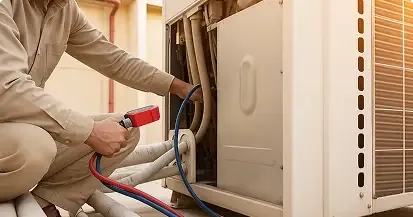
Technicians disconnect refrigerant lines, electrical connections, and condensate drains before removing the failed coil. Access limitations frequently require cutting refrigerant lines and re-brazing connections after coil installation. Proper brazing technique proves critical—overheating copper tubing during soldering introduces scale formation inside refrigerant circuits that can migrate to expansion valves and cause blockages. Nitrogen purging during brazing prevents oxidation by displacing oxygen from the work area.
New coil installation requires precise leveling to ensure condensate flows properly to drain connections. Even 2-3 degrees of tilt away from the drain can cause water accumulation and overflow. Technicians install new filter driers during evaporator replacement to capture moisture and contaminants that entered the system during the service process. These driers prevent compressor damage by removing particles and acids that form during refrigerant exposure to air and moisture.
System evacuation follows installation, using vacuum pumps to remove air and moisture from refrigerant circuits. Proper evacuation requires pulling system pressure below 500 microns and maintaining that vacuum for 15-30 minutes to verify leak-free connections. Moisture remaining in systems causes ice formation at metering devices and accelerates acid formation that corrodes internal components.
After successful evacuation, technicians charge the system with refrigerant according to manufacturer specifications—either by weight for critically charged systems or by superheat/subcooling measurements for field-adjustable systems.
Preventive Strategies to Maximize Evaporator Lifespan
Property owners can implement several practices that substantially extend evaporator coil life. Filter replacement represents the single most impactful maintenance task, as clean filters prevent dust accumulation on coil surfaces. Standard 1-inch filters require monthly replacement during peak usage seasons, while higher-efficiency 4-inch media filters last 6-12 months. Systems operating in dusty environments or homes with pets need more frequent filter changes—sometimes as often as every two weeks.
Maintaining proper airflow prevents many evaporator problems. Homeowners should ensure all supply and return registers remain unobstructed by furniture, drapes, or storage items. Closing more than 20% of registers in a forced-air system creates back-pressure that reduces evaporator airflow and may trigger high-pressure safety shutoffs. Ductwork inspections every 5-7 years identify deteriorated connections, crushed flex duct, or disconnected sections that compromise airflow.
Annual professional maintenance provides opportunities for early problem detection before minor issues escalate to system failures. Comprehensive maintenance includes evaporator inspection, condensate drain cleaning, refrigerant pressure verification, and airflow measurement. Service agreements with qualified contractors reduce emergency air conditioning repair near me situations by identifying developing problems during scheduled visits rather than discovering failures during heat waves when technician availability is limited and premium rates apply.
Indoor air quality improvements indirectly protect evaporator coils by reducing corrosive compounds in circulated air. Homes using gas appliances should ensure proper combustion venting, as incomplete combustion produces formic acid that attacks copper refrigerant lines. Similarly, certain cleaning products, air fresheners, and building materials emit volatile organic compounds that contribute to formicary corrosion. Using low-VOC products and maintaining adequate ventilation reduces coil exposure to these damaging chemicals.
Humidity control protects evaporator components from excessive condensate production that accelerates corrosion. Indoor humidity above 60% during cooling seasons creates moisture loads that evaporator coils cannot adequately remove, leading to standing water in drain pans. Whole-house dehumidifiers or enhanced ventilation systems maintain humidity in the optimal 40-50% range, reducing corrosion risk and improving occupant comfort. The investment in humidity control equipment—typically $1,200-$2,800 installed—pays dividends through extended HVAC component life and reduced biological growth.
Cost Analysis and Return on Investment
Understanding evaporator service costs helps property owners budget appropriately for both routine maintenance and unexpected repairs. Professional coil cleaning averages $200-$350 for residential systems, with commercial applications ranging from $400-$1,200 depending on tonnage and accessibility. These cleaning services restore 12-18% efficiency loss in systems that haven't received maintenance in 3-5 years, translating to monthly energy savings of $25-$60 for typical residential installations.
Evaporator leak repair costs vary considerably based on leak location and system refrigerant type. Simple repairs to accessible line sets cost $225-$400, while leaks in the coil core requiring coil replacement run $1,200-$3,200 total. Systems using R-410A refrigerant incur lower refrigerant costs than legacy R-22 equipment, where refrigerant alone can cost $80-$150 per pound due to production phase-out. A complete system recharge typically requires 2-4 pounds per ton of cooling capacity.
Complete evaporator coil replacement represents a significant investment but delivers measurable returns. Residential installations average $1,500-$2,800 including labor, parts, and refrigerant. Commercial systems range from $2,500-$8,000 depending on capacity and installation complexity.
New coils restore factory efficiency specifications, reducing energy consumption by 15-35% compared to degraded coils. For a 3-ton residential system consuming $150 monthly in cooling costs, efficiency restoration saves $22-$52 monthly, recovering installation costs in 30-50 months through energy savings alone.
The decision calc between repairing your a/c evaporator or replacing the entire system depends on equipment age and overall condition.


