





Professional HVAC Services for Residential and Commercial Systems

The Current State of the HVAC Industry and What It Means for Property Owners
The heating, ventilation, and air conditioning sector represents a $240 billion global market, with North American demand accounting for approximately 38% of that figure. Recent data from the Bureau of Labor Statistics indicates a projected 6% growth in HVAC technician positions through 2032, outpacing the average for all occupations. This expansion reflects the increasing complexity of climate control systems and the rising consumer expectation for immediate, expert-level service.
Property managers and homeowners face a fundamental challenge: modern air conditioning and heating equipment requires specialized knowledge that extends far beyond the basic maintenance practices of previous decades. Variable-speed compressors, smart thermostats, zoned systems, and refrigerant regulations create an environment where professional intervention has shifted from optional to essential. The consequences of improper maintenance or delayed repairs now carry greater financial weight, with system replacements averaging between $5,000 and $12,000 for residential installations.
The demand for qualified technicians has never been higher. According to industry workforce studies, 69% of HVAC contractors report difficulty finding trained personnel, creating a service gap that directly affects response times and pricing structures in many markets. This shortage makes the selection of reliable, properly staffed service providers more critical than ever.
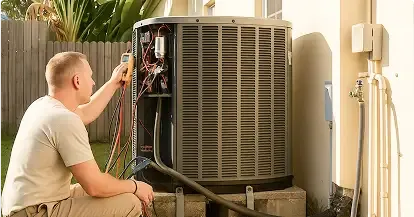
Why Regular Professional Maintenance Delivers Measurable Returns
Data from the Department of Energy demonstrates that well-maintained HVAC systems operate 15% to 20% more efficiently than neglected units. This efficiency translates directly to utility costs. A residential system consuming 3,000 kilowatt-hours per cooling season at standard rates of $0.13 per kWh represents $390 in annual electricity costs. A 20% efficiency loss adds $78 annually, compounding over the typical 15-year lifespan of a quality air conditioning unit.
Professional maintenance addresses specific performance degradation points. Dirty evaporator coils reduce heat transfer capacity, forcing longer run times. Refrigerant charge discrepancies—either over or under the manufacturer specification—decrease efficiency by 5% to 20%. Worn blower motors draw excess amperage. Clogged condensate drains lead to secondary water damage averaging $3,000 to $5,000 per incident according to insurance claim data.
Certified technicians follow established protocols during maintenance visits. These include amperage draws on all motors, refrigerant pressure verification at both liquid and suction lines, temperature differential measurements across coils, electrical connection integrity checks, and combustion analysis for gas-fired equipment. Each measurement creates a baseline for future comparison, allowing early detection of component degradation before complete failure occurs.
The frequency question matters. Manufacturers typically specify annual inspections for residential systems and quarterly service for commercial installations. Properties in desert climates or coastal environments often benefit from increased inspection frequency due to airborne particulates and salt corrosion. The $150 to $300 cost of a comprehensive maintenance visit represents a fraction of the emergency repair costs that average $450 to $850 per incident.
Emergency Service Requirements and Response Protocol Standards
System failures follow predictable patterns tied to equipment load. Air conditioning breakdowns spike during the first sustained heat wave of summer when systems transition from idle status to continuous operation. Heating system failures cluster during the initial cold snaps of late autumn. These peak demand periods test service provider capacity and response infrastructure.
The concept of emergency service carries specific operational requirements. True around-the-clock availability means staffed phone lines, not answering services. It requires dispatch protocols, stocked service vehicles, and technicians compensated for irregular hours. Many providers advertise emergency service but maintain limited after-hours capability, creating response delays that extend into multiple business days during peak seasons.
Response time benchmarks vary by market density and provider commitment. Urban markets with established service networks typically achieve two to four-hour response windows during business hours. Rural areas often see eight to twelve-hour windows. After-hours and weekend response generally adds two to four hours to these baselines.
Commercial properties face distinct emergency parameters. A failed HVAC system in a medical facility, data center, or food service operation creates immediate operational and safety concerns. These environments require service contracts with guaranteed response times, often specified in minutes rather than hours. The premium for such guarantees ranges from 30% to 100% above standard residential emergency service rates.
Temperature extremes add urgency. Interior temperatures in uncontrolled spaces can reach dangerous levels within hours during summer heat events. The Centers for Disease Control reports that extreme heat contributes to approximately 1,220 deaths annually in the United States, with elderly populations and individuals with chronic health conditions facing elevated risk. Winter heating failures pose hypothermia risks and frozen pipe damage averaging $5,000 to $7,000 per incident.
Cost Structures and Pricing Transparency in HVAC Services
The financial architecture of climate control services reflects labor intensity, technical training requirements, and equipment investment. A fully equipped service vehicle carries $15,000 to $35,000 in diagnostic tools, refrigerant recovery equipment, and common replacement components. Technician training involves 6 to 24 months of classroom instruction and field experience before certification. These investments establish baseline service costs that consumers should understand.
Diagnostic fees typically range from $75 to $200, depending on geographic market and service provider positioning. This charge covers travel, initial system assessment, and problem identification. Many providers waive diagnostic fees when customers approve recommended repairs, though this practice varies. The fee-waiver model incentivizes repair approval but can create pressure on marginal repair decisions.
Repair pricing follows parts-plus-labor structures. Common residential repairs include capacitor replacement ($150 to $300), contactor replacement ($150 to $400), blower motor replacement ($450 to $650), and compressor replacement ($1,800 to $2,800). Labor rates range from $75 to $150 per hour depending on market conditions and technician certification level. Parts markup typically runs 25% to 40% above wholesale cost, covering inventory investment and warranty administration.
Commercial work commands premium rates. Service calls start at $150 to $350, reflecting specialized equipment knowledge and off-hours scheduling requirements. Larger tonnage systems require specialized tools and additional technician training. Three-ton residential repairs rarely translate directly to fifteen-ton commercial applications in complexity or cost.
Flat-rate pricing has gained adoption across the industry. This model establishes fixed prices for specific repairs regardless of completion time. Proponents argue it eliminates customer concern about technician efficiency and provides cost certainty. Critics note that it can inflate pricing on straightforward repairs while subsidizing complex ones. Consumer preference data shows mixed results, with 48% preferring flat-rate and 52% preferring time-and-materials according to recent surveying.

The Critical Distinction Between Repair and Replacement Decisions
Equipment age fundamentally alters repair economics. A seven-year-old system with a failed compressor presents different cost-benefit calculations than a fifteen-year-old unit with the same failure. Industry guidelines suggest replacement consideration when repair costs exceed 50% of replacement cost for units beyond their median lifespan.
Median lifespan data provides decision guidance. Central air conditioners average 15 to 20 years with proper maintenance. Furnaces extend to 20 to 25 years for gas units and 20 to 30 years for electric models. Heat pumps typically reach 15 years in moderate climates but may decline to 10 to 12 years in regions requiring year-round operation. Boilers often exceed 30 years when properly maintained.
Efficiency considerations affect replacement timing. A system manufactured in 2005 operates at 10 SEER (Seasonal Energy Efficiency Ratio) compared to current minimum standards of 14 SEER in northern regions and 15 SEER in southern states. Premium equipment reaches 20 to 26 SEER. The efficiency delta translates to 30% to 60% operating cost reductions for high-efficiency replacements.
Refrigerant phase-outs create additional pressure points. R-22 refrigerant production ceased in 2020 under EPA regulations, though servicing of existing equipment remains legal using reclaimed refrigerant. R-22 costs have increased from $10 per pound in 2015 to $50 to $90 per pound currently. Systems requiring three to five pounds for a recharge face $250 to $450 in refrigerant costs alone, making leak repairs on older systems economically questionable.
Professional assessment should include system matching analysis. Outdoor condensing units and indoor air handlers require proper pairing for rated efficiency. Mismatched components—common in piecemeal replacement approaches—reduce efficiency by 10% to 20%. Ductwork condition, insulation levels, and air sealing affect system performance regardless of equipment quality.
Commercial HVAC Requirements and Service Complexity Factors
Commercial climate control systems operate under fundamentally different parameters than residential installations. A 50,000-square-foot office building may utilize multiple rooftop units totaling 150 tons of cooling capacity, compared to the three to five tons typical in residential applications. This scale introduces complexity in system design, maintenance scheduling, and failure impact.
Planned maintenance becomes non-negotiable in commercial environments. ASHRAE (American Society of Heating, Refrigerating and Air-Conditioning Engineers) standards recommend quarterly inspections for most commercial systems, with monthly checks for critical applications. These protocols include vibration analysis, oil sampling, electrical load verification, and economizer function testing—procedures that extend beyond residential service scope.
Building automation systems add another layer of complexity. Modern commercial installations integrate HVAC control with occupancy sensors, daylight harvesting, demand response protocols, and energy management systems. Troubleshooting requires expertise in both mechanical systems and digital controls, creating a specialized technician subset within the broader HVAC workforce.
Service contracts dominate commercial relationships. Typical agreements specify response times, coverage scope, parts inclusion, and preventive maintenance frequency. Pricing structures range from time-and-materials with guaranteed response to comprehensive coverage including parts, labor, and replacement at fixed annual fees. Contract costs typically run $0.15 to $0.40 per square foot annually for basic preventive maintenance, scaling to $0.75 to $1.50 per square foot for comprehensive coverage.
Regulatory compliance creates additional service requirements. Commercial kitchens require specialized ventilation and makeup air systems with mandated cleaning schedules. Medical facilities operate under strict humidity and filtration standards. Many jurisdictions require annual inspections and certifications for commercial HVAC systems, adding documentation requirements to service protocols.
Regional Climate Variables and Their Service Implications
Geographic location substantially affects both equipment selection and maintenance requirements. Cooling-dominated climates in the southern United States see air conditioning systems operating 2,000 to 3,000 hours annually, compared to 500 to 1,000 hours in northern regions. This differential affects component wear patterns, maintenance scheduling, and replacement intervals.
Heating requirements follow inverse patterns. Natural gas furnaces in Minnesota may cycle 3,500 to 4,500 hours per heating season, while similar equipment in Georgia operates 800 to 1,200 hours. Heat pumps in moderate climates provide efficient year-round operation but lose effectiveness below 25°F to 30°F, requiring supplemental heat in cold climates.
Humidity levels complicate system design and maintenance. Coastal regions and the Southeast face persistent high humidity that taxes dehumidification capacity and promotes biological growth in ductwork and drain pans. Arid western climates reduce latent cooling loads but introduce dust infiltration and increased air filter replacement frequency.
Salt air in coastal environments accelerates corrosion on outdoor equipment. Aluminum fins on condensing units pit and corrode, copper refrigerant lines develop pinhole leaks, and electrical connections corrode at accelerated rates. Manufacturers offer coastal-rated equipment with enhanced coatings and corrosion-resistant materials commanding 15% to 25% price premiums.
Altitude affects equipment performance and sizing. Locations above 3,000 feet see reduced air density that affects combustion efficiency and heat transfer capacity. De-rating factors of 4% per 1,000 feet above sea level apply to many equipment specifications, requiring larger capacity units to achieve equivalent performance.

Certification Standards and What They Mean for Service Quality
Professional certification serves as quality verification in an industry where licensing requirements vary dramatically by jurisdiction. North American Technician Excellence (NATE) provides the most widely recognized certification program, with approximately 40,000 certified technicians nationwide. NATE testing covers installation, service, and specialty areas including heat pumps, gas heating, air conditioning, and commercial refrigeration.
EPA Section 608 certification addresses refrigerant handling, required by federal law for anyone working with systems containing refrigerants. Four certification levels exist: Type I (small appliances), Type II (high-pressure systems), Type III (low-pressure systems), and Universal (all types). This certification verifies knowledge of refrigerant properties, recovery procedures, and environmental regulations.
Manufacturer-specific training adds another credential layer. Major equipment manufacturers including Carrier, Trane, Lennox, and Rheem offer certification programs covering their product lines. These programs teach proper installation techniques, warranty requirements, and troubleshooting protocols specific to each manufacturer's equipment.
State licensing requirements vary substantially. California requires a C-20 contractor license for HVAC work, involving examination and experience verification. Texas mandates TDLR licensure for air conditioning contractors. Florida requires state certification and local licensing in many jurisdictions. Other states maintain minimal or no specific HVAC licensing requirements, allowing general contractor licenses to cover climate control work.
The certification gap matters to service outcomes. Studies by industry training organizations show certified technicians identify system problems correctly on first diagnosis 78% of the time, compared to 52% for uncertified personnel. This accuracy differential reduces diagnostic time, minimizes unnecessary part replacement, and improves first-visit completion rates.
Energy Efficiency Improvements and Available Incentive Programs
Utility costs represent 60% to 70% of total HVAC lifecycle expenses for most installations, making efficiency improvements financially significant. Modern variable-speed equipment adjusts output to match load requirements rather than cycling on and off at full capacity. This modulation reduces energy consumption by 20% to 40% compared to single-stage equipment while improving humidity control and temperature stability.
Smart thermostat technology adds 8% to 12% efficiency improvement through optimized scheduling and learning algorithms. These devices cost $200 to $350 installed and qualify for utility rebates in many service territories. Annual savings of $120 to $180 create payback periods of 18 to 24 months according to EPA Energy Star calculations.
Duct sealing addresses a major efficiency loss point. Department of Energy research indicates that 20% to 30% of conditioned air escapes through duct leakage in typical residential systems. Professional duct sealing using mastic or aerosol-based products reduces this loss to 5% to 10%, improving system efficiency by 15% to 20%. The service costs $800 to $1,500 for average residential applications.
Federal tax credits currently provide 30% of installation cost up to $600 for qualified central air conditioners and $2,000 for heat pumps under the Inflation Reduction Act provisions through 2032. State and utility incentives add to federal programs. California offers $3,000 to $7,000 through various programs for heat pump installations. Northeast states provide $500 to $1,200 rebates through efficiency-focused utility programs.
Air quality improvements deliver health benefits alongside efficiency gains. MERV 13 filtration removes 85% to 90% of airborne particles including bacteria, mold spores, and fine dust. UV germicidal irradiation systems installed in air handlers reduce microbial growth and associated odors. These improvements cost $400 to $1,200 installed and require minimal ongoing energy consumption.
Selecting Service Providers: Evaluation Criteria That Matter
Provider selection affects both immediate service quality and long-term equipment performance. Several objective criteria enable informed decisions. Business longevity indicates market acceptance and operational stability. Companies operating 10 to 15 years or longer demonstrate sustained service quality and financial viability.
Insurance verification protects property owners from liability. Legitimate service companies carry general liability coverage of $1 million to $2 million and workers compensation insurance for all employees. Certificate of insurance provides verification, though direct confirmation with insurance carriers offers additional assurance.
Written estimates establish accountability. Detailed proposals should specify equipment models, warranty terms, labor costs, permit fees, and completion timelines. Verbal estimates or vague proposals create dispute potential and suggest unprofessional operations.
Reference checking reveals service patterns. Property owners should request three to five recent customer contacts and follow through with calls. Specific questions about punctuality, cleanliness, problem resolution, and post-service support provide insight into operational practices.
Price positioning offers information but requires context. The lowest bid frequently indicates corner-cutting on labor hours, parts quality, or proper installation procedures. The highest bid may reflect premium service or simple overpricing. Competitive bids typically cluster within 15% to 20% for equivalent scope, with outliers requiring scrutiny.
Online review patterns deserve analysis with appropriate skepticism. A company with 200 reviews averaging 4.7 stars shows more reliable performance than one with 15 reviews at 5.0 stars. Recent reviews matter more than historical ratings, as personnel and management changes affect service quality. Responses to negative reviews indicate customer service commitment and problem resolution approaches.
The climate control sector continues evolving technically and operationally. Understanding service requirements, cost structures, and provider selection criteria enables property owners to make decisions that balance immediate comfort needs with long-term financial efficiency.