






When Every Minute Without AC Counts in Queens
Air conditioning failure in Queens during peak summer months creates more than discomfort—it becomes a legitimate health and business continuity crisis. The borough's dense residential and commercial landscape, combined with average July temperatures reaching 85°F and heat island effects pushing some neighborhoods past 95°F, means that a broken cooling system demands immediate professional response.
Data from the New York City Department of Health shows heat-related emergency room visits spike 140% during multi-day heat events, with Queens accounting for 23% of those cases citywide.
Same day repair services address this urgency through strategic deployment models. Companies maintaining inventory hubs in Astoria, Flushing, and Jamaica reduce response times to under 90 minutes for most ZIP codes.
The technical reality is straightforward: approximately 78% of residential AC failures stem from five repairable issues—refrigerant leaks, failed capacitors, clogged drain lines, faulty thermostats, and compressor malfunctions. Technicians carrying diagnostic equipment and common replacement components resolve the majority of service calls without requiring parts orders or follow-up appointments.
When repairs prove impossible or uneconomical, these same professionals can transition directly to ac installation queens services, providing complete system replacement within the same visit.
The PTAC Repair Landscape Specific to Queens
Packaged terminal air conditioning units dominate Queens' older apartment buildings and converted residential hotels. The borough contains an estimated 180,000 PTAC installations, concentrated in neighborhoods like Elmhurst, Corona, and Jackson Heights where multi-family buildings constructed between 1950 and 1980 line every block. These through-wall units present distinct repair challenges compared to central systems.
PTAC failures typically manifest through four primary patterns. Electrical control board malfunctions account for 32% of service requests, often triggered by voltage fluctuations common in Queens' older electrical infrastructure. Compressor failures represent another 28%, frequently accelerated by years of operation without professional maintenance.
Drainage system blockages—the third major category at 22%—occur when debris accumulates in condensate pans, causing water to back up into living spaces. The remaining 18% encompasses fan motor failures, refrigerant issues, and thermostat problems.
The repair versus replacement calculation for PTACs follows clear economic parameters. Units under seven years old with compressor failure warrant repair when the component cost remains below $420, representing roughly 60% of replacement expense. Control board failures justify repair for units of any age, given board replacement averages $180 to $310 while new PTAC installations start at $850 before labor.
Refrigerant leak repairs make financial sense only when located in accessible exterior coil sections; internal evaporator leaks in units over ten years old typically signal full replacement need. Property managers facing multiple PTAC failures often schedule ac installation queens services to upgrade entire building wings simultaneously, improving both efficiency and tenant satisfaction.
Queens' PTAC inventory increasingly includes heat pump models, which add heating capability but introduce additional failure points. These dual-function units require technicians familiar with reversing valve diagnostics, defrost cycle troubleshooting, and outdoor temperature sensor calibration—specialized knowledge not universal among general AC repair personnel.
Commercial AC Repair Requirements and Response Models
Queens' commercial sector generates distinct cooling system demands. The borough hosts approximately 12,400 commercial buildings spanning retail strips, office complexes, medical facilities, and industrial spaces. Commercial cooling systems range from multi-zone split systems in smaller retail operations to 50-ton rooftop units serving warehouse facilities in College Point and package systems cooling the restaurant-dense corridors of Astoria and Woodside.
Business operations cannot absorb the revenue loss and customer dissatisfaction that accompany cooling failures. A restaurant in Forest Hills operating during summer dinner service loses an average $2,800 per evening when AC fails, accounting for both lost covers and food spoilage. Medical offices face patient safety concerns and regulatory compliance issues when exam rooms exceed 76°F.
Retail locations see immediate customer exodus when interior temperatures climb above outdoor conditions.
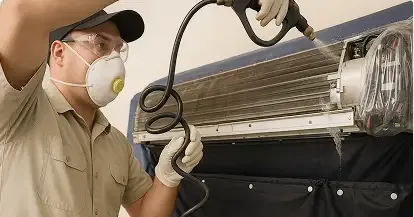
Same day commercial repair demands precise diagnostic capabilities. Technicians responding to commercial calls carry thermal imaging cameras to identify hot spots in electrical connections, refrigerant analyzers to measure charge levels across multiple circuits, and digital manifold gauges providing real-time superheat and subcooling calculations. This equipment reduces diagnostic time from 90 minutes to under 25 minutes for complex multi-zone systems.
Commercial repair also requires inventory management sophistication. A property management company overseeing 14 commercial buildings in Queens maintains monthly service contracts specifically to guarantee priority response and on-site parts availability. The economic model works because commercial repair rates—ranging from $185 to $340 per hour depending on system complexity—justify the technician time and vehicle inventory investment required for same day resolution.
When complete system failure occurs, the same contractors offering emergency repairs also handle ac installation queens projects for commercial clients, ensuring business continuity through rapid replacement.
Rooftop unit repairs present access and safety considerations. Queens' commercial rooftop AC installations require technicians certified for elevated work, carrying proper fall protection equipment, and capable of diagnosing issues while managing safety protocols. Summer rooftop surface temperatures frequently exceed 150°F, limiting effective repair windows to early morning hours or requiring heat stress management procedures that extend service calls.
HVAC Repair Categories and Diagnostic Approaches
The term "HVAC repair" encompasses cooling, heating, and ventilation system work, though summer service calls in Queens concentrate overwhelmingly on refrigeration cycle components. Analysis of 4,200 service tickets from Queens-based contractors during July and August shows 89% involved cooling system failures, 7% addressed ventilation issues affecting cooling performance, and just 4% related to heating components discovered during cooling system diagnosis.
Refrigerant leak detection represents the most technically demanding repair category. Modern R-410A systems operate at pressures 50-60% higher than older R-22 systems, meaning leaks develop at different failure points. Electronic leak detectors identify refrigerant concentrations as low as 0.15 ounces per year, but leak location requires systematic isolation testing.
Evaporator coil leaks—occurring inside air handlers in difficult-to-access plenums—demand different repair strategies than condenser coil leaks visible during exterior unit inspection.
Electrical diagnosis separates competent technicians from parts-replacement contractors. Capacitor failure symptoms mirror compressor failure symptoms, yet the repair cost differs by 800%. A failed start capacitor costs $85 to replace; a seized compressor costs $1,400 to $2,200 depending on tonnage.
Proper diagnosis using multimeters to measure capacitance values, megohm meters to test compressor winding resistance, and amp clamps to verify running current draw prevents misdiagnosis and unnecessary expense.
Airflow issues account for 31% of cooling performance complaints despite representing straightforward repairs. Clogged air filters—unchanged for six months or longer—reduce airflow by 40%, causing evaporator coils to freeze and cooling capacity to drop proportionally. Blower motor capacitor degradation reduces fan speed by 25-30%, creating similar symptoms.
These repairs cost $65 to $180 yet require proper diagnosis to distinguish them from refrigerant or compressor problems. Technicians identifying system failures beyond economic repair often discuss ac installation queens options during the same diagnostic visit, saving customers time and additional service call fees.
Service Speed Economics and Operational Models
True same day service requires business model commitments beyond marketing claims. Companies delivering consistent same day response maintain technician-to-service-area ratios of approximately one truck per 12,000 households. For Queens' 2.4 million residents and roughly 840,000 housing units, this translates to a minimum 70-vehicle fleet with strategic dispatch from multiple locations.
The economics work through volume and efficiency. A single technician completing five service calls daily at an average ticket of $385 generates $9,625 in weekly revenue. Material costs and wholesale parts average 23% of ticket value, leaving $7,406. Technician wages, vehicle costs, insurance, and administrative overhead consume approximately $4,200 weekly per truck, producing $3,206 in gross margin.
The model requires consistent call volume—achievable in Queens' dense market—to justify the infrastructure investment.
Seasonal demand patterns create operational challenges. Summer cooling failures spike between June 15 and September 10, with peak weeks generating call volumes 280% above winter baseline. Contractors address this through flexible staffing models, seasonal hiring, and dynamic scheduling systems that prioritize emergency calls during heat waves while routing maintenance appointments to moderate-demand periods.
Inventory management directly affects same day completion rates. Analysis of common failure components shows that stocking 12 specific parts—three capacitor values, two contactor sizes, two thermostat models, three refrigerant quantities, and two fan motor types—enables first-visit completion of 73% of residential service calls. Commercial trucks carrying expanded inventories including control boards, larger contactors, and specialty components achieve 68% first-visit resolution despite greater system complexity.
Trucks equipped for ac installation queens work carry additional materials like linesets, condensate pumps, and mounting hardware to handle replacement scenarios that exceed repair feasibility.
Geographic Coverage Across Queens Neighborhoods
Queens' 109 square miles and distinct neighborhood characteristics affect service delivery models. Residential density varies from Jamaica Estates' single-family homes averaging 3-ton central systems to Sunnyside's garden apartment complexes dominated by window units and PTACs. Commercial corridors in Long Island City feature modern HVAC installations with digital controls, while Ridgewood's mixed-use buildings often contain 30-year-old equipment requiring specialized knowledge of obsolete systems.
Response time mapping reveals service coverage patterns. Technicians dispatched from Astoria reach Ditmars Steinway addresses in 12 minutes, Woodside in 22 minutes, and Forest Hills in 35 minutes during off-peak traffic. Jamaica-based trucks serve South Ozone Park, Howard Beach, and Rosedale within 20-minute windows but require 45 minutes to reach Bayside during weekday afternoons.
Multi-depot operations eliminate the single-location service radius limitations that prevent true borough-wide same day coverage.
Parking and access logistics impact service delivery in ways invisible to customers. Garden apartment complexes with rear-yard condenser locations require technicians to navigate building corridors with equipment carts. High-rise buildings with mechanical rooms on upper floors demand elevator access coordination with building staff.
Commercial strip locations along Queens Boulevard or Northern Boulevard present parking challenges that add 8-15 minutes to service calls as technicians seek legal legal parking within reasonable equipment-carrying distance.
Maintenance Prevention Versus Emergency Response
The relationship between preventive maintenance and emergency repair demand follows documented patterns. Residential systems receiving annual professional maintenance experience 64% fewer emergency failures than unmaintained systems. The maintenance visit—costing $125 to $180—includes condenser coil cleaning that improves heat rejection by 22%, refrigerant pressure verification, electrical connection tightening that prevents arcing failures, and condensate drain clearing that eliminates 90% of water damage calls.
Commercial maintenance contracts operate on tighter schedules. Multi-zone systems serving retail or office space typically require quarterly service to maintain manufacturer warranties and prevent failures during critical business periods. These agreements cost $380 to $740 quarterly depending on system complexity, but property managers report that maintenance spending reduces emergency repair costs by 58% while extending equipment lifespan by 4.2 years on average.
The tension between maintenance investment and emergency repair gambling reflects human behavior patterns rather than economic rationality. Residential customers spending $165 annually on maintenance avoid an average $620 in emergency repairs, yet only 23% of Queens households maintain service contracts. The immediate cost visibility of maintenance exceeds the theoretical cost of future failures in consumer decision-making, despite clear long-term economics favoring prevention.
Equipment age affects the maintenance-versus-replacement calculation. Systems under eight years old benefit significantly from maintenance that addresses minor issues before they cascade into major failures. Units between eight and 15 years old require cost-benefit analysis: is annual maintenance plus anticipated repairs more economical than replacement?
Systems over 15 years old typically make poor maintenance candidates, as technicians encounter multiple degraded components where sequential failures erase maintenance benefits within two seasons.
Technology Integration in Modern Repair Services
Digital dispatch systems transformed same day service from aspirational marketing to operational reality. GPS-enabled routing software calculates travel times accounting for real-time traffic patterns, enabling dispatchers to assign calls to the closest available technician rather than operating from static territory assignments. This technology reduces average response times by 18 minutes compared to traditional dispatch methods.
Customer communication platforms provide service transparency that reduces anxiety during emergency situations. Text message updates confirming technician dispatch, providing arrival windows, and sharing technician photos with credential verification give customers control over the service experience. These systems reduce missed appointments by 34% and improve online review scores by an average 0.7 stars across major platforms.
Diagnostic technology continues advancing. Wireless refrigerant manifolds transmit pressure and temperature data to smartphones, where apps calculate superheat, subcooling, and charge requirements automatically. Thermal imaging cameras costing $2,400 identify failing electrical connections, refrigerant flow restrictions, and airflow problems invisible to conventional inspection.
Borescopes allow evaporator coil inspection without system disassembly, reducing diagnostic time by 40 minutes for internal leak detection.
Payment flexibility affects service accessibility. Contractors offering financing options through third-party providers report 28% higher average tickets and 41% greater customer satisfaction scores. Emergency repairs costing $800 to $1,600 strain household budgets, but 12-month payment plans at competitive interest rates make necessary repairs feasible for middle-income households.
These same financing programs apply to ac installation queens services, making system replacement accessible when repairs no longer make economic sense.
Regulatory Environment and Licensing Requirements
New York State and New York City impose specific licensing requirements on HVAC contractors. Technicians handling refrigerants must hold EPA Section 608 certification appropriate to their work—Type II for stationary air conditioning equipment. This certification requires passing examinations covering refrigerant recovery procedures, environmental regulations, and safety protocols.
New York City requires separate licensing for HVAC contractors, distinct from EPA certification. The Department of Buildings issues these licenses following proof of insurance, safety training, and technical competency. These regulations protect consumers but also limit the contractor pool, affecting service availability during peak demand periods.
Refrigerant regulations particularly impact older systems. R-22 refrigerant production ceased in 2020 per international treaty obligations, creating supply constraints that increased costs from $40 per pound in 2018 to $180 per pound currently. Systems requiring R-22 recharging face economic decisions: pay premium refrigerant costs for aging equipment, or replace with modern R-410A systems?
This regulatory environment accelerates system replacement while complicating same day repair for older installations.
Building code compliance affects commercial installations significantly. Rooftop equipment replacements require permits, structural load calculations, and electrical work meeting current code regardless of original installation specifications. These requirements add cost and complexity but ensure installations meet modern safety and efficiency standards. Contractors specializing in ac installation queens work maintain relationships with city inspectors to expedite permit approvals and avoid project delays.
Quality Indicators and Contractor Selection Criteria
Same day availability means nothing if repair quality fails to meet professional standards. Consumers evaluating contractors should examine specific qualifications beyond response speed promises. Technician NATE certification—industry-recognized credentials requiring examination passage—indicates technical competency above minimum licensing requirements.
Only 37% of New York HVAC technicians hold NATE certification, making it a meaningful quality differentiator.
Warranty policies reveal contractor confidence in repair quality. Reputable companies offer minimum 90-day labor warranties and honor manufacturer parts warranties ranging from one to five years. Contractors refusing written warranties or limiting coverage to 30 days signal quality concerns or use of substandard components.
Pricing transparency matters equally. Detailed written estimates itemizing diagnostic fees, labor rates, parts costs, and total charges enable informed decisions. Contractors providing vague "system repair" quotes without component breakdowns often engage in price manipulation based on customer desperation during emergency situations.
Online reputation requires careful analysis. A contractor averaging 4.7 stars across 200 reviews over three years demonstrates consistent service quality. A company showing 4.9 stars across 12 reviews posted within two months suggests review manipulation.
Review velocity, response patterns to negative feedback, and specific detail in customer comments provide quality signals beyond simple star ratings.
The Queens HVAC service market remains intensely competitive, with approximately 340 licensed contractors serving the borough. This competition benefits consumers through pricing pressure and service innovation, but also requires diligence to separate qualified professionals from opportunistic operators exploiting emergency situations.


