







Understanding PTAC Heat Pump Systems
Packaged Terminal Air Conditioner heat pumps represent a specialized category of HVAC equipment designed for single-room climate control in commercial and multi-family residential environments. Unlike traditional central air systems, each PTAC unit operates independently, providing both heating and cooling through a self-contained chassis that mounts through an exterior wall. The heat pump variant adds reverse-cycle capability, enabling the system to extract thermal energy from outdoor air even in moderate cold conditions. Visit acrepair for more.
The market for these units reached $2.1 billion in North America during 2022, driven primarily by hospitality sector demand and multifamily housing construction. Hotels account for approximately 68% of all installations, where the ability to control costs through individual room management creates measurable operational advantages. Property managers typically see 15-22% energy savings compared to central systems when rooms remain unoccupied for extended periods.
PTAC heat pump configurations differ fundamentally from cooling-only models through the addition of a reversing valve and supplementary electric resistance heaters. The reversing valve redirects refrigerant flow, allowing the outdoor coil to serve as an evaporator during heating mode. Most manufacturers integrate 3-5 kW electric heat strips that activate automatically when outdoor temperatures drop below the heat pump's effective operating range, typically 35-40°F depending on the model.
Major PTAC Heat Pump Manufacturers and Models
GE Zoneline PTAC Systems
General Electric dominates the commercial PTAC market with its Zoneline series, holding an estimated 34% market share across North America. The current AZ65 and AZ95 model lines deliver 7,000 to 15,000 BTU cooling capacity with heating outputs ranging from 6,800 to 14,200 BTU. GE Zoneline PTAC units incorporate micro-channel heat exchangers that reduce refrigerant charge by 30% compared to previous generations while maintaining equivalent thermal performance.
Field service data indicates GE PTAC models average 12-15 years of operational life in hospitality environments with proper maintenance schedules. The company's DigiSmart control technology, standard on mid-tier and premium models, enables networked building management integration through ModBus protocols. Property operators report 18-24% energy reduction when implementing occupancy-based setback programming across 100+ room installations.
Common failure points on GE Zoneline equipment include capacitor degradation after 4-6 years, fan motor bearing wear at 8-10 years, and control board moisture damage in humid coastal climates. Replacement parts remain readily available through authorized distributors, with compressor assemblies priced between $320-$580 depending on capacity. The standardized 42-inch sleeve dimensions ensure compatibility across most GE model generations since 2008.
Amana PTAC Heat Pump Options
Amana entered the packaged terminal equipment market in 1997 and currently offers five distinct product lines targeting different commercial applications. The DigiSmart series competes directly with GE's premium offerings, while the PTC and PTH model families serve budget-conscious operators. Amana PTAC units use scroll compressors exclusively, which generate 4-7 dB less sound pressure than reciprocating alternatives at equivalent capacity ratings.
Installation contractors note that Amana PTAC systems ship with pre-charged linesets and require no field brazing for standard through-wall applications. This design choice reduces installation time by 35-45 minutes per unit compared to brands requiring refrigerant connections. The company maintains regional service centers in 23 metropolitan areas, enabling next-business-day parts delivery for 89% of the continental United States.
Amana's heat pump models incorporate demand defrost algorithms that monitor coil temperature differentials rather than relying on fixed-interval defrost cycles. This approach reduces unnecessary defrost events by 40-50% in mild winter climates, preserving heating capacity and minimizing compressor cycling. Units equipped with this feature demonstrate 8-12% improved seasonal heating efficiency compared to time-based defrost controls.
The Amana PTAC warranty structure provides comprehensive coverage that extends five years on sealed systems, giving property managers confidence in long-term reliability.
Islandaire PTAC Specifications
Islandaire maintains manufacturing facilities in New Jersey and specializes in custom configurations for marine, high-rise, and corrosive-environment applications. The company's VTC Series incorporates enhanced corrosion protection with e-coat primer and polyester powder topcoats rated for 3,000-hour salt spray exposure. Coastal hotels and beachfront condominiums represent 71% of Islandaire's annual sales volume.
These units feature heavier-gauge cabinet construction than typical PTAC equipment, with 18-gauge galvanized steel chassis compared to the industry-standard 20-22 gauge materials. The additional structural integrity proves valuable in high-wind zones where building pressurization creates significant stress on through-wall penetrations. Islandaire PTAC systems carry Miami-Dade County product approval for hurricane-prone regions, meeting NOA requirements for wind-borne debris impact resistance.
Service technicians encounter fewer refrigerant leak issues with Islandaire equipment due to factory-brazed copper connections and reinforced service port assemblies. The company reports warranty claim rates 23% below industry averages for sealed system failures. Standard warranty coverage extends five years on compressors and two years on components, with optional extended protection available for commercial installations exceeding 50 units.
PTAC Heat Pump Installation Requirements
Professional installation of packaged terminal equipment demands precise wall penetration sizing and structural support preparation. The standard rough opening measures 42 inches wide by 16 inches high, though height requirements vary by manufacturer between 15.5 and 16.5 inches. Load-bearing walls require header reinforcement capable of supporting 180-220 pounds of equipment weight plus seasonal ice accumulation in northern climates.
Wall sleeve installation must maintain proper pitch toward the exterior, typically 0.25 inches over the 16-inch depth, to ensure condensate drainage. Improper sleeve angle causes water accumulation inside the chassis, leading to premature control board failure and mold growth within the cabinet. Municipalities enforcing the 2018 or later International Building Code require flashing integration with weather-resistant barriers on all through-wall HVAC penetrations.
Electrical requirements for PTAC heat pump installations include dedicated 208-230V circuits with ampacity ranging from 15 to 30 amps depending on heating capacity and auxiliary heat strip wattage. Code-compliant installations position disconnects within sight of the equipment and within 50 feet of the unit location. Ground fault protection requirements vary by jurisdiction, with California Title 24 mandating GFCI protection for all hotel and motel PTAC circuits since 2020.
Outdoor grille placement affects both operational efficiency and building aesthetics. Units installed below second-floor level require protective grilles or expanded metal screening to prevent vandalism and debris intrusion. The grille must maintain free airflow across the entire coil face, with minimum 12-inch clearance from landscaping, walls, or other obstructions.
Restricted airflow reduces capacity by 3-5% for every 10% reduction in free area. When installing an Amana PTAC, contractors should verify grille compatibility with the manufacturer's airflow specifications to maintain optimal performance.
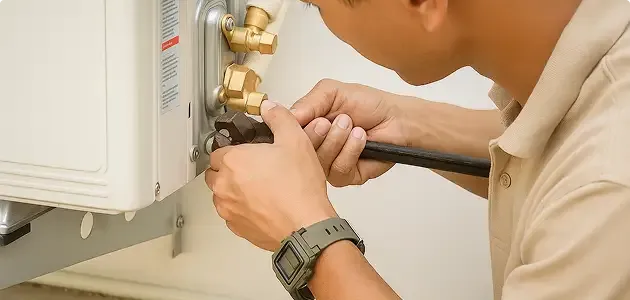
Common PTAC Heat Pump Repair Issues
Compressor failure represents the most expensive repair scenario for PTAC units, with replacement costs ranging from $450 to $850 including labor and refrigerant. Scroll compressor failures typically result from liquid slugging caused by clogged outdoor coils or failed defrost controls. Reciprocating compressor damage correlates strongly with low refrigerant charge and subsequent loss of oil circulation. Most compressor warranties require documented proof of annual maintenance to remain valid.
Control board malfunctions account for 28% of all service calls on PTAC equipment according to HVAC trade association data. Moisture infiltration through poorly sealed outdoor grilles causes corrosion on printed circuit traces and relay contacts. Salt air environments accelerate this degradation, reducing typical board life from 10-12 years to 5-7 years in coastal installations. Conformal coating provides modest protection but requires factory application to prove effective.
Capacitor replacement represents the most frequent repair intervention, typically required every 5-7 years depending on ambient temperature exposure and cycling frequency. Both compressor run capacitors and fan motor capacitors degrade through dielectric breakdown and electrolyte evaporation. Failed capacitors cause hard starting, reduced capacity, and eventual motor damage if not addressed promptly. Technicians stock 35, 40, 45, and 50 microfarad ratings to cover 85% of field applications.
Refrigerant leaks develop most commonly at service port connections, compressor terminals, and brazed joints on older equipment. R-410A systems operate at 50-70% higher pressures than legacy R-22 equipment, accelerating leak development at mechanical connections. EPA regulations require proper refrigerant recovery before repairs, adding $75-$150 to service costs depending on system charge quantity.
Leak detection using electronic sensors or ultraviolet dyes typically adds 30-45 minutes to diagnostic time. Technicians servicing an Amana PTAC often find that factory-sealed connections reduce leak incidents compared to field-assembled alternatives.
PTAC vs Mini Split Comparison Analysis
Building operators frequently evaluate packaged terminal equipment against ductless mini-split systems when planning renovations or new construction. The decision matrix involves upfront costs, installation complexity, energy efficiency, and maintenance accessibility. PTAC units deliver lower first costs, averaging $1,200-$1,800 installed per room compared to $2,500-$4,200 for mini-split systems of equivalent capacity.
Mini-split systems achieve superior energy efficiency ratings, with SEER values reaching 20-26 versus 10-13 for typical PTAC equipment. This efficiency advantage translates to 35-45% lower operating costs in moderate climates where heating and cooling demands remain balanced. The gap narrows in extreme climates where electric resistance heat supplements both system types, reducing the mini-split's efficiency advantage to 20-25%.
Installation timeframes favor PTAC units significantly when infrastructure already exists. Replacing existing equipment requires 2-3 hours per unit versus 6-8 hours for mini-split installations requiring new refrigerant linesets and condensate drainage. Hotels and apartment buildings benefit from the modular replacement approach, allowing room-by-room upgrades without disrupting adjacent spaces. Mini-split installations typically require building-wide coordination to route linesets and position outdoor condensing units.
Maintenance accessibility creates another decision point. PTAC units slide completely from wall sleeves for service, enabling filter changes, coil cleaning, and component replacement without specialized tools or refrigerant handling. Mini-split indoor units require on-site service for most repairs, with outdoor condenser access sometimes complicated by rooftop or balcony mounting locations. Labor rates for mini-split service average 25-35% higher than PTAC work due to increased technical complexity.
Aesthetic considerations increasingly influence system selection in upscale hospitality and residential applications. Mini-split indoor units offer sleeker profiles and quieter operation, with sound levels measuring 19-32 dBA versus 42-48 dBA for PTAC equipment. The visible outdoor grilles and audible fan noise of packaged terminal units create objections in premium properties. Conversely, the self-contained nature of PTAC systems eliminates concerns about outdoor condenser placement and associated visual impact.
Energy Efficiency Optimization Strategies
Regular coil cleaning maintains thermal transfer efficiency and prevents the 15-25% capacity loss that develops over three years of neglected maintenance. Outdoor coils accumulate lint, leaves, and atmospheric particulates that insulate fin surfaces and restrict airflow. Professional cleaning services using alkaline detergents and pressurized water restore airflow to within 5% of new equipment performance. Hotels implementing quarterly coil cleaning protocols report 12-18% energy consumption reduction compared to annual maintenance schedules.
Filter replacement intervals directly impact both energy efficiency and indoor air quality. Standard fiberglass filters require monthly replacement in commercial environments, while higher-efficiency pleated filters extend intervals to 60-90 days. Restricted filters increase fan power consumption by 8-12% while reducing overall capacity. Some property managers install filter monitoring systems that alert maintenance staff when pressure drops exceed factory-specified limits.
Programmable thermostat installation enables occupancy-based setback strategies that reduce runtime in unoccupied spaces. Hotels achieve 20-30% energy savings by raising cooling setpoints to 78-80°F and lowering heating setpoints to 60-62°F when rooms remain vacant. Networked control systems integrate with property management software to adjust temperatures automatically based on reservation status. The technology investment typically achieves payback within 18-24 months for properties exceeding 75 rooms.
Outdoor temperature lockout controls prevent heating operation when ambient conditions exceed economical heat pump operation. Most PTAC units operate efficiently down to 35-40°F outdoor temperature before electric resistance heat becomes the primary heat source. Lockout controls disable heating requests when outdoor temperatures exceed 65°F, preventing guest-initiated energy waste. Implementation requires low-voltage control modifications and professional programming to avoid comfort complaints.
Long-Term Performance and Replacement Planning
Industry data indicates properly maintained PTAC heat pump systems deliver 12-18 years of reliable service before requiring complete replacement. Hotels typically establish rotating replacement schedules that address 6-10% of inventory annually, spreading capital costs while maintaining equipment age diversity. This approach prevents the operational and financial disruption of simultaneous building-wide failures that occur when all units reach end-of-life together.
Replacement decisions should factor efficiency improvements available in current equipment generations. Units manufactured after 2018 incorporate variable-speed fan motors, improved heat exchangers, and advanced control algorithms that deliver 25-35% energy savings compared to 2010-era equipment. The incremental equipment cost of $150-$250 per unit typically achieves payback within 4-6 years through reduced utility expenses. Properties upgrading to current-generation Amana PTAC models benefit from these efficiency improvements while maintaining compatibility with existing wall sleeves.
Standardizing on a single manufacturer simplifies parts inventory, reduces technician training requirements, and enables volume purchase discounts. Properties maintaining 100+ PTAC units negotiate directly with manufacturers for 15-25% discounts off distributor pricing. Service agreements bundling preventive maintenance with priority parts access provide budget predictability and minimize downtime during peak occupancy periods.
Building automation system integration capabilities should guide equipment selection for properties planning future technology upgrades. Modern PTAC units offer BACnet, Modbus, and proprietary protocol options for networked control. This connectivity enables centralized monitoring, fault diagnostics, and energy management beyond simple occupancy setback. The incremental cost of communication-ready equipment adds $80-$120 per unit but facilitates operational improvements worth multiples of the initial investment.


