







Why Professional AC Installation Matters in Brooklyn's Climate
Brooklyn homeowners face a unique set of environmental challenges when cooling their properties. The borough's dense urban landscape creates heat islands where temperatures climb 5 to 7 degrees higher than surrounding areas. Visit acrepair for more.
According to NOAA data, Brooklyn records an average of 19 days per year exceeding 90°F, with humidity levels regularly topping 70 percent during summer months. These conditions demand properly sized and professionally installed cooling systems.
DIY installations or contractor errors lead to measurable consequences. Systems installed without load calculations consume 20 to 30 percent more energy than correctly sized units. Poor refrigerant charging reduces efficiency by up to 40 percent while shortening compressor lifespan by years.
Insurance carriers now require professional installation documentation for warranty coverage. Homeowner policies typically exclude claims arising from unpermitted HVAC work.
The New York City Department of Buildings mandates permits for central air installations and most ductless mini-split systems, with fines starting at $2,500 for unpermitted work.
Professional installers complete load calculations using Manual J protocols, accounting for building orientation, insulation values, window placement, and occupancy patterns. This engineering approach prevents the oversizing that plagues 60 percent of residential installations nationwide. Oversized units short-cycle, failing to remove humidity while wasting energy on frequent startups.
Central Air vs. Ductless Systems: Brooklyn Installation Considerations
Brooklyn's housing stock shapes installation decisions. The borough contains 350,000 residential buildings, with brownstones, pre-war apartments, and row houses dominating many neighborhoods. These structures present distinct challenges for cooling system installation.
Central air conditioning requires ductwork that many older Brooklyn homes lack. Installing ducts in finished spaces costs $3,500 to $7,000 beyond equipment expenses.
Limited attic and basement space in typical Brooklyn construction often makes duct routing impossible without major renovations. Buildings with radiator heating lack the forced-air infrastructure that simplifies central AC installation.
Ductless mini-split systems solve these constraints. These configurations place compact air handlers in individual rooms, connected to outdoor compressors through refrigerant lines requiring only three-inch wall penetrations. Installation typically completes in one day without drywall demolition or dropped ceilings.
Brooklyn installations average 2.3 indoor units per outdoor compressor. Single-zone systems serve studios and one-bedroom apartments, while multi-zone configurations cool larger floor plans. Compressor capacity ranges from 9,000 BTU units for small rooms to 36,000 BTU systems handling entire floors.
Energy efficiency considerations favor ductless technology. Duct losses consume 25 to 40 percent of cooling energy in typical central systems, according to Department of Energy research.
Ductless equipment eliminates these losses while offering zone control that reduces waste. SEER ratings for quality ductless systems reach 30, compared to 16 for standard central air.
Window units remain common in rental properties where permanent installations require landlord approval. These portable solutions cool individual rooms but operate inefficiently compared to installed systems. Window AC units average SEER ratings of 10, consuming two to three times more electricity per BTU than ductless equipment.
The Brooklyn HVAC Installation Process: What to Expect
Professional installation follows documented procedures that separate qualified contractors from unlicensed operators. The process begins with an on-site assessment examining existing electrical service, exterior wall conditions, and interior layout.
Load calculations determine required cooling capacity using building measurements and construction details. Contractors measure wall, window, and door areas; note insulation presence; record ceiling heights; and assess sun exposure. Software processes these inputs using ACCA Manual J methodology, outputting precise tonnage requirements.
Electrical capacity verification comes next. Most central air systems require 240-volt circuits with 30 to 60 amp capacity. Ductless systems need dedicated 120-volt or 240-volt circuits sized to equipment specifications.
Brooklyn buildings constructed before 1980 often require panel upgrades costing $1,500 to $3,000 before HVAC installation proceeds.
Permit applications submit to the NYC Department of Buildings, typically processing within 10 business days. Licensed electricians must file separately for electrical work. Installations proceeding without permits risk stop-work orders, equipment removal mandates, and compounding fines reaching $25,000.
Installation day activities vary by system type. Central air projects involve outdoor condenser placement on concrete pads, refrigerant line routing, indoor evaporator coil integration with furnace or air handler, condensate drain installation, and thermostat wiring.
Ductwork inspection and sealing addresses existing distribution systems. Total installation time ranges from 8 to 16 hours for straightforward projects.
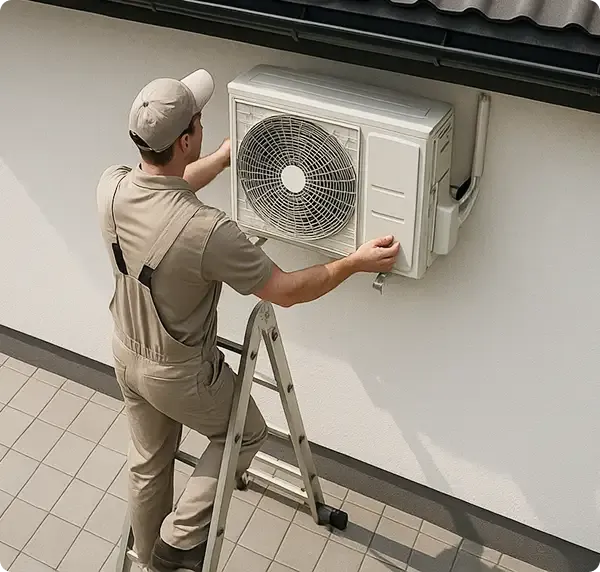
Ductless installations move faster. Technicians mount outdoor compressors on brackets or ground stands, drill penetrations for refrigerant lines and electrical connections, mount indoor air handlers on walls or ceilings, and vacuum refrigerant lines before charging systems.
Typical single-zone installations complete in 4 to 6 hours; multi-zone projects require 8 to 12 hours.
Startup procedures include refrigerant charge verification using superheat and subcooling measurements, airflow testing at each register or air handler, thermostat calibration, and system operation under load. Documentation should include equipment specifications, warranty registrations, and maintenance schedules.
Sizing Your System Correctly: Brooklyn-Specific Factors
Brooklyn's architectural diversity demands customized sizing approaches. Standard rules of thumb stating "one ton per 500 square feet" fail in real-world applications, leading to the chronic oversizing that undermines comfort and efficiency.
Building age significantly impacts cooling loads. Pre-war construction with solid masonry walls and minimal insulation requires more capacity than modern buildings meeting current energy codes. A 1920s brownstone might need 30 BTU per square foot, while a 2015 condo requires only 18 BTU per square foot.
Floor level affects requirements in multi-story buildings. Top-floor units absorb solar heat through roofs, increasing loads by 15 to 25 percent compared to middle floors. Corner units with multiple exterior walls need 10 percent additional capacity versus interior units buffered by neighboring spaces.
Window characteristics drive major load variations. South and west-facing windows receive intense afternoon sun, adding 1,000 to 1,500 BTU per window to cooling requirements. Single-pane windows in older buildings transmit three times more heat than modern double-pane low-e glass.
Occupancy patterns allow load reductions through zone control. Bedrooms used primarily at night need less capacity than specifications based on continuous occupancy. Ductless systems excel here, concentrating cooling in occupied zones while maintaining minimal airflow elsewhere.
Kitchen equipment creates internal heat loads requiring additional capacity. Commercial-grade ranges add 3,000 to 5,000 BTU to cooling requirements. Home offices with multiple computers and monitors generate 500 to 1,000 BTU per workstation.
Proper sizing typically yields tonnage requirements 15 to 30 percent below quick estimates. A 1,000-square-foot apartment might require only 18,000 BTU (1.5 tons) instead of the 24,000 BTU (2 tons) suggested by generic calculations. This right-sizing delivers better humidity control, quieter operation, and lower operating costs.
Electrical and Structural Requirements for Brooklyn Installations
Brooklyn's aging infrastructure creates installation challenges requiring specialized knowledge. Most borough residential buildings predate modern electrical codes, operating with 100-amp or smaller main panels. Modern HVAC systems demand capacity these services cannot provide.
Central air conditioners draw 15 to 30 amps at 240 volts depending on tonnage. A three-ton system requires a dedicated 30-amp circuit, consuming 7,200 watts at peak operation. Buildings with electric cooking, water heating, and clothes drying may lack available capacity for air conditioning loads.
Licensed electricians calculate total connected load against main panel capacity, determining whether upgrades are necessary. Panel replacements cost $2,000 to $4,000 including permits and utility coordination.
Service upgrades from 100 to 200 amps require utility company involvement, adding $1,500 to $3,000 in connection fees.
Ductless systems offer advantages for capacity-constrained buildings. Smaller single-zone units operate on 120-volt, 15-amp circuits that fit within existing capacity. Multi-zone systems require 240-volt service but draw less power than equivalent central air tonnage because of superior efficiency.
Structural considerations affect outdoor equipment placement. Brooklyn zoning regulations restrict rooftop equipment installation in landmarked districts covering Park Slope, Brooklyn Heights, Fort Greene, and other historic neighborhoods.
Landmark Preservation Commission approval adds three to six months to project timelines with no guarantee of approval.
Ground-level condenser placement requires concrete pads measuring 30 by 30 inches minimum, set on stable, level ground. Installation too close to property lines violates zoning setback requirements. Clearances of 24 inches on service sides and 12 inches on remaining sides ensure adequate airflow and maintenance access.
Wall-mounted equipment must anchor into solid masonry or structural framing. Typical outdoor units weigh 80 to 150 pounds; brackets must withstand this load plus wind forces.
Brick veneer common in Brooklyn construction requires mounting hardware that penetrates to backup walls or structural elements.
Refrigerant line routing through exterior walls demands weatherproof sealing preventing air and water infiltration. Penetrations through historic masonry should minimize visible impact, often requiring creative routing through inconspicuous locations. Interior chases conceal lines in finished spaces but add installation complexity and cost.
Energy Efficiency Standards and Brooklyn Utility Costs
New York State energy codes establish minimum efficiency requirements affecting equipment selection. Current standards mandate SEER 15 for split systems and SEER 14 for packaged units installed in New York City. These minimums represent baseline performance; quality ac installation brooklyn projects specify higher-efficiency equipment.
Con Edison electricity rates make efficiency investments economically compelling. Brooklyn residential customers pay approximately $0.20 per kilowatt-hour including supply and delivery charges during summer months. High-efficiency equipment delivers measurable savings at these rates.
SEER ratings indicate seasonal efficiency across varied operating conditions. Each SEER point improvement reduces cooling costs by roughly 7 percent.
Upgrading from SEER 14 baseline equipment to SEER 21 cuts energy consumption by 33 percent, saving $200 to $400 annually for typical Brooklyn households running systems five months yearly.
ENERGY STAR certification identifies products exceeding minimum standards by significant margins. ENERGY STAR central air conditioners meet SEER 16 minimums; ductless systems qualify at SEER 15. These products often include advanced features like variable-speed compressors and improved refrigerants enhancing performance beyond basic efficiency metrics.
Variable-speed technology delivers efficiency gains exceeding SEER ratings alone. Traditional single-speed compressors operate at full capacity or shut off completely, cycling frequently and wasting energy.
Variable-speed systems modulate output from 25 to 100 percent, matching capacity to loads precisely. This operation reduces cycling losses while improving humidity removal and temperature stability.
Smart thermostat integration maximizes efficiency through automated scheduling and remote control. These devices learn occupancy patterns, pre-cooling spaces before arrival while reducing output during absences.
Utility time-of-use rates reward this load shifting; running systems during off-peak hours saves 30 to 50 percent versus peak periods.
Proper refrigerant charging proves as important as equipment efficiency ratings. Systems undercharged by 10 percent lose 20 percent efficiency; overcharging by 10 percent cuts efficiency 5 to 10 percent. Professional installation includes precise charging based on manufacturer specifications and verified superheat measurements.
Maintenance Requirements After Installation
Newly installed systems require regular maintenance protecting equipment investments and preserving efficiency. Neglected systems lose 5 percent efficiency yearly, doubling energy costs within a decade while increasing failure risk.
Filter maintenance represents the most critical owner responsibility. Standard one-inch filters need monthly replacement during cooling season.
Dirty filters restrict airflow, forcing systems to work harder while reducing capacity. Severely restricted airflow causes evaporator coil freeze-ups requiring service calls costing $150 to $300.
Annual professional maintenance should occur before each cooling season. Technicians inspect electrical connections, measure refrigerant charge, clean condenser and evaporator coils, verify proper drainage, test safety controls, and measure system performance.
This preventive service costs $120 to $200 but prevents 95 percent of mechanical failures according to HVAC industry data.
Condenser coils accumulate dirt, pollen, and debris blocking airflow. Brooklyn's urban environment accelerates this accumulation with particulate matter from vehicle exhaust and construction activity.
Annual coil cleaning maintains heat transfer efficiency; neglected coils reduce capacity by 15 to 30 percent within three years.
Condensate drain lines require periodic clearing preventing water damage. Air handlers produce gallons of condensate daily during humid Brooklyn summers. Clogged drains cause overflow damaging ceilings, walls, and floors.
Drain line maintenance includes algae treatment and vacuum clearing, taking 15 minutes during annual service visits.
Ductless air handler filters wash clean with water every two weeks during active use. These permanent filters dry quickly and reinstall easily. Clean filters ensure optimal airflow and indoor air quality while preventing internal component contamination.
Refrigerant leaks develop over time from vibration, corrosion, and connection failures. Systems losing refrigerant operate inefficiently while risking compressor damage.
Annual charge verification during maintenance visits catches slow leaks before causing expensive failures. Refrigerant costs $50 to $150 per pound; compressor replacement runs $1,200 to $2,500.
Warranty protection depends on documented professional maintenance. Most manufacturers require annual service by licensed technicians as warranty conditions. Missing this maintenance voids coverage, leaving owners responsible for repair costs that otherwise would be covered.
Choosing the Right Brooklyn HVAC Contractor
Contractor selection determines installation quality and long-term satisfaction. Brooklyn's competitive HVAC market includes 300-plus companies ranging from one-person operations to regional firms with dozens of technicians. This variety complicates selection but allows careful comparison.
Licensing verification should be the first screening step. New York City requires HVAC contractors to hold Home Improvement Contractor licenses issued by the Department of Consumer Affairs.
License numbers appear on estimates and marketing materials; verification takes minutes through the city's online database. Unlicensed contractors cannot obtain permits or provide warranty protection.
Insurance coverage protects homeowners from liability and ensures contractor accountability. General liability policies covering $1 million minimum protect against property damage during installation.
Workers compensation insurance covers technician injuries; homeowners face liability for uninsured worker injuries occurring on their property. Request certificate of insurance copies before work begins.
Experience with specific system types matters more than years in business. Contractors specializing in ac installation brooklyn understand mounting techniques, refrigerant line sizing, and condensate management that differ from central air work. Ask for references from similar installations in comparable Brooklyn properties.
Written estimates should detail equipment specifications including model numbers, efficiency ratings, and warranty terms. Labor costs, permit fees, electrical work, and additional materials require separate line items. Vague estimates with single total prices prevent meaningful comparison and hide potential upcharges.
Equipment options at multiple price points let homeowners balance budgets against features. Contractors offering only premium brands or insisting on unnecessary upgrades raise concerns. Conversely, quotes featuring unknown brands or specification downgrades to meet price targets compromise long-term value.
Timeline commitments with installation dates hold contractors accountable. Peak season scheduling books weeks in advance; flexible homeowners get better rates and faster service by scheduling spring or fall ac installation brooklyn appointments.
Customer reviews provide insight into contractor reliability and service quality. Online platforms like Google, Yelp, and HomeAdvisor aggregate feedback from previous clients.
Look for patterns in reviews rather than isolated complaints. Contractors with consistent five-star ratings across hundreds of reviews demonstrate sustained quality. Pay attention to how companies respond to negative feedback; professional resolution of complaints indicates customer service commitment.
References from recent ac installation brooklyn projects allow direct conversation with satisfied customers. Ask about timeline adherence, cleanup quality, post-installation support, and whether final costs matched estimates. Contractors hesitant to provide references raise red flags.


