






Understanding the Queens AC Installation Market
New York City's Queens borough presents unique challenges for climate control systems. With over 2.3 million residents across 108 square miles, Queens represents the largest borough by area and second-largest by population.
Summer temperatures regularly climb into the high 80s and low 90s, while humidity levels frequently exceed 70 percent. These conditions create sustained demand for reliable air conditioning systems across residential, commercial, and mixed-use properties.
Property types in Queens range from pre-war apartment buildings in Astoria to modern high-rises in Long Island City, from single-family homes in Bayside to commercial strips along Queens Boulevard. Each structure type demands specific installation approaches.
Pre-1950 buildings often lack existing ductwork, requiring ductless mini-split systems or extensive retrofitting. Newer construction may accommodate central air systems but requires precise load calculations to match system capacity with building envelope performance.
The Queens HVAC market operates under stringent New York City building codes and Department of Buildings regulations. Installation work requires licensed professionals holding valid New York State certifications.
The city's Local Law 97, enacted in 2019 as part of the Climate Mobilization Act, imposes greenhouse gas emission caps on buildings larger than 25,000 square feet starting in 2024. This regulation pushes property owners toward higher-efficiency systems, reshaping installation priorities across the borough.
System Selection for Queens Properties
Selecting appropriate equipment for Queens air conditioning installations begins with accurate cooling load calculations. The Air Conditioning Contractors of America recommends Manual J calculations that account for building orientation, insulation values, window areas, occupancy patterns, and internal heat loads.
A typical 1,200-square-foot Queens apartment might require a 24,000 BTU system, but actual requirements vary by 30 percent or more based on these factors.
Central air conditioning systems remain the standard for single-family homes and townhouses. These configurations pair outdoor condensing units with indoor air handlers connected through refrigerant lines and ductwork.
Seasonal Energy Efficiency Ratio ratings now start at 13 SEER for new installations under federal minimums, but Energy Star-certified units achieve 15 SEER or higher. Each SEER point above the minimum reduces operating costs by approximately 7 percent in typical residential applications.
Ductless mini-split systems have captured significant market share in Queens due to their flexibility in buildings without existing duct systems. These installations place individual air handlers in separate zones, each controlled independently.
A three-bedroom apartment might use three wall-mounted units connected to a single outdoor compressor. Installation costs run $3,000 to $5,000 per zone on average, but elimination of ductwork often offsets this premium in retrofit applications.
Commercial properties present additional complexity. Rooftop package units dominate retail and light commercial installations, combining all components in single weatherproof enclosures.
Variable refrigerant flow systems serve larger commercial spaces, modulating refrigerant flow to match instantaneous demand across dozens of indoor units. Office buildings in downtown Flushing and Long Island City increasingly specify VRF technology for its 30 to 40 percent energy savings compared to conventional systems.
The Installation Process from Assessment to Startup
Professional AC installation queens projects begin with comprehensive site assessments. Technicians evaluate electrical service capacity, structural support for equipment mounting, condensate drainage paths, and refrigerant line routing.
Many Queens buildings operate on 100-amp electrical services that require upgrades to support modern high-efficiency air conditioners drawing 30 to 50 amps during peak operation.
Permit acquisition represents a critical early step. New York City requires permits for new AC installations and major system replacements.
The Department of Buildings reviews submitted plans for code compliance before authorizing work. Processing times range from two weeks to two months depending on project scope and DOB workload. Experienced contractors maintain relationships with expeditors who navigate this bureaucracy efficiently.
Equipment staging follows permit approval. Installers coordinate deliveries to minimize disruption in dense urban environments where parking restrictions and building access limitations complicate logistics.
Outdoor condensing units for multi-story buildings often require crane lifts to rooftops or exterior mounting platforms. A typical crane rental in Queens costs $1,500 to $3,000 for half-day service, factored into total installation pricing.
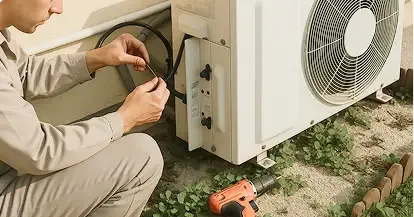
The physical installation sequence begins with outdoor unit placement on vibration-isolating pads or roof curbs. Technicians drill precisely sized holes through exterior walls for refrigerant lines, maintaining minimal penetration diameter to preserve building envelope integrity.
Line sets run through these penetrations, secured with proper hangers and protected with weather-resistant insulation. Indoor components mount according to manufacturer specifications, with air handlers positioned for optimal airflow distribution.
Electrical connections require licensed electricians in New York City. Dedicated circuits terminate at disconnect boxes near outdoor units, sized according to equipment specifications.
Most residential systems demand 240-volt circuits with 30 to 60-amp capacity. Commercial installations may require three-phase power distribution and more complex electrical integration with building management systems.
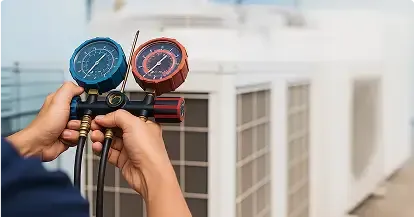
Refrigerant charging represents the final technical step. Technicians evacuate air and moisture from line sets using vacuum pumps, then charge systems to manufacturer-specified levels.
Proper charging directly impacts efficiency and longevity—systems undercharged by 10 percent lose approximately 20 percent efficiency, while overcharging by the same margin reduces capacity by 10 percent. Digital manifold gauges measuring superheat and subcooling ensure precise charging.
Queens-Specific Installation Considerations
Historic preservation regulations affect installations in designated landmark districts across Queens. Jackson Heights Historic District, comprising 2,200 buildings, restricts exterior alterations including AC unit placement.
Property owners must submit applications to the Landmarks Preservation Commission, which reviews visual impact and architectural compatibility. Approved installations typically require screening or recessed mounting to minimize visibility from street level.
Building density in neighborhoods like Elmhurst and Corona creates logistical challenges. Row houses share common walls, limiting exterior mounting locations.
Multi-family buildings place outdoor units on rooftops, balconies, or exterior walls with structural capacity to support 200 to 400-pound equipment loads. Installers must verify structural adequacy through building documentation or engineering assessments before mounting heavy condensing units.
Noise regulations under the New York City Noise Code limit air conditioner sound levels to 42 decibels at property lines in residential districts. Modern inverter-driven compressors operate at 50 to 65 decibels at the source, requiring strategic placement away from bedroom windows and property boundaries.
Sound-attenuating enclosures or barriers reduce noise levels by 10 to 15 decibels when necessary for code compliance.
Coastal proximity affects equipment selection in southern Queens neighborhoods like Rockaway Beach and Broad Channel. Salt air accelerates corrosion on aluminum fins and copper components.
Manufacturers offer coastal-rated units with corrosion-resistant coatings that extend service life from 10-12 years to 15-20 years in marine environments. These units carry 15 to 25 percent price premiums but prove economical over their extended operational periods.
Professional ac installation queens contractors in these areas routinely recommend corrosion-resistant equipment for waterfront properties.
Commercial AC Installation Requirements
Queens commercial ac repair providers emphasize preventive installation practices that reduce future service demands. Commercial systems operate longer duty cycles than residential units—12 to 16 hours daily versus 6 to 8 hours—accelerating wear on components.
Installation quality directly impacts reliability and maintenance costs over 15 to 20-year equipment lifespans.
Proper airflow configuration prevents common commercial HVAC failures. Supply and return ducts sized below ACCA Manual D standards create excessive velocity, increasing noise and pressure drop.
A 5-ton commercial system requires approximately 2,000 cubic feet per minute of airflow. This volume demands 14-inch diameter ducts or equivalent rectangular cross-sections, with actual sizing adjusted for run length and configuration.
Condensate management becomes critical in commercial installations. A 10-ton rooftop unit produces 15 to 20 gallons of condensate daily during peak cooling seasons.
Drain lines require proper pitch—minimum quarter-inch per foot—and trap configuration to prevent airflow from blocking drainage. Secondary drain pans with dedicated overflow sensors protect buildings from water damage when primary systems fail.
Control system integration separates basic commercial installations from optimized ones. Programmable thermostats reduce runtime during unoccupied hours, cutting energy consumption by 20 to 30 percent.
Building automation systems coordinate HVAC operation with occupancy sensors, demand-controlled ventilation, and utility demand response programs. Queens commercial properties participating in Con Edison demand response programs receive $150 to $300 per kilowatt of peak demand reduction annually.
Energy Efficiency and Regulatory Compliance
Local Law 97 compliance drives equipment selection for affected Queens properties. Buildings exceeding emission limits face penalties of $268 per ton of carbon dioxide equivalent over allowable limits.
A 100,000-square-foot office building typically generates 500 to 800 tons of carbon emissions annually. High-efficiency HVAC systems reduce these emissions by 100 to 200 tons, avoiding $26,800 to $53,600 in annual penalties.
Variable-speed compressor technology delivers significant efficiency gains over single-stage units. Traditional air conditioners operate at full capacity or off, cycling frequently and consuming excess energy during startup.
Variable-speed systems modulate output from 40 to 100 percent, matching capacity to real-time loads. Laboratory testing shows 30 to 40 percent energy savings, though field performance typically achieves 20 to 30 percent reductions depending on climate and usage patterns.
Smart thermostat integration extends efficiency beyond equipment specifications. Learning thermostats adjust schedules based on occupancy patterns, reducing unnecessary runtime.
Geofencing activates cooling as residents approach home, balancing comfort with efficiency. Con Edison offers $85 rebates for qualifying smart thermostats, and the devices typically reduce cooling costs by $80 to $150 annually in Queens climate conditions.
Refrigerant selection affects both efficiency and environmental impact. The American Innovation and Manufacturing Act mandates 85 percent reduction in hydrofluorocarbon production and consumption by 2036.
R-410A, the current residential standard, faces phasedown pressure. New equipment increasingly uses R-32 refrigerant with 68 percent lower global warming potential. Installers must verify that selected systems use refrigerants with long-term regulatory viability to ensure your ac installation queens investment remains compliant with evolving standards.
Cost Factors and Investment Analysis
Air conditioner repair queens service calls average $150 to $300 for diagnostic visits, with actual repair costs depending on component failures and labor requirements. New installations represent significant capital investments that eliminate these recurring expenses while providing warranty coverage.
Understanding total cost of ownership guides rational investment decisions.
Residential central air installations in Queens range from $4,500 to $9,000 for typical systems serving 1,200 to 2,000 square feet. This range encompasses equipment costs of $2,000 to $4,000, labor charges of $1,500 to $3,000, and materials including refrigerant lines, electrical components, and ductwork modifications.
High-efficiency systems or complex installations push costs toward the upper range.
Ductless mini-split installations cost $3,000 to $5,000 per zone for quality equipment and professional installation. A three-zone system serving a typical Queens apartment runs $9,000 to $15,000.
These costs include outdoor condensing units, indoor air handlers, installation labor, electrical work, and wall penetrations. Multi-zone installations achieve economies of scale, with per-zone costs declining as system size increases.
Commercial installations scale with building size and system complexity. Small retail spaces might install 5-ton package units for $8,000 to $12,000 installed.
Mid-sized office buildings requiring 20 to 30 tons of cooling capacity invest $40,000 to $80,000 in rooftop equipment and associated controls. Large commercial projects specifying variable refrigerant flow technology may exceed $200,000 for comprehensive installations.
Operating costs significantly impact long-term economics. Con Edison residential electric rates average 22 cents per kilowatt-hour including delivery charges.
A 3-ton air conditioner operating 1,200 hours annually at 13 SEER consumes approximately 2,800 kilowatt-hours, costing $615 yearly. A 16 SEER unit reduces consumption to 2,280 kilowatt-hours and $500 annual cost.
Over a 15-year service life, the high-efficiency unit saves $1,725 in energy costs.
Maintenance Planning for Longevity
Queens HVAC systems require annual professional maintenance to sustain performance and efficiency. Neglected air conditioners lose 5 percent efficiency annually, accumulating 25 percent degradation over five years.
Regular maintenance preserves factory efficiency levels and identifies developing problems before they cause system failures.
Comprehensive maintenance visits include refrigerant level verification, electrical connection inspection, condensate drain cleaning, coil washing, and airflow measurement. Technicians check compressor amperage draw against nameplate specifications to detect motor degradation.
Filter replacement or cleaning occurs quarterly or monthly depending on usage and air quality conditions.
Maintenance agreements from queens ac repair providers typically cost $150 to $300 annually for residential systems. These contracts include scheduled inspections, priority service scheduling, and discounts on repairs.
Commercial maintenance contracts scale with system size and complexity, ranging from $500 to $3,000 annually for equipment serving 5,000 to 20,000 square feet.
Component replacement follows predictable timelines. Capacitors fail after 5 to 7 years, requiring $150 to $300 replacements.
Contactor switches wear out over similar periods at comparable costs. Compressors represent the most expensive components, with replacement costs of $1,200 to $2,500 including labor.
Proactive maintenance extends compressor life from 10-12 years to 15-18 years through proper lubrication and operating condition maintenance.
Choosing Qualified Installation Contractors
New York State requires HVAC technicians to hold valid certifications for refrigerant handling and installation work. EPA Section 608 certification authorizes refrigerant purchases and system servicing.
The certification requires passing examinations covering proper handling, leak detection, and recovery procedures. Contractors should readily provide proof of current certification upon request.
Insurance coverage protects property owners from liability during installation work. General liability insurance covers property damage from installation activities, while workers compensation protects against employee injury claims.
Queens contractors should carry minimum $1 million general liability coverage and state-required workers compensation. Request certificates of insurance before authorizing work.
Industry affiliations signal professional commitment and ongoing training. Air Conditioning Contractors of America membership requires adherence to professional standards and provides continuing education.
North American Technician Excellence certification validates technical competency through standardized testing. These credentials indicate contractors who maintain current knowledge of evolving technologies and installation best practices.
Customer reviews provide installation quality indicators beyond credentials. Platforms like Google Business and Yelp aggregate customer experiences, highlighting patterns of reliability or problems.
Review volume matters—contractors with 50-plus reviews offer more reliable quality signals than those with fewer data points. Recent reviews carry more weight than outdated feedback from different service teams.
Obtaining multiple installation quotes enables informed decision-making. Three estimates provide sufficient comparison data without excessive time investment.
Detailed quotes should itemize equipment specifications, labor charges, materials costs, and warranty coverage. The lowest bid rarely represents the best value when comparing different equipment tiers or installation thoroughness.
Strategic Installation Timing
Seasonal demand fluctuations affect ac installation queens scheduling and pricing throughout the year. Spring months from March through May represent optimal installation windows.
Contractors maintain full availability before peak cooling season begins, and equipment manufacturers offer promotional pricing to drive early-season sales. Installation costs may run 10 to 15 percent below summer peak pricing during these months.
Emergency replacement during summer heat waves costs significantly more than planned installations.


