Best AC repair
in Manhattan, 2026
In brief. AC repair in Manhattan is dominated by pre-war co-ops with PTAC through-wall units and high-rise condos with split systems. Board alteration agreements, freight-elevator scheduling, and Landmarks Preservation rules regularly change how the job is quoted. Every contractor ranked here holds a DCWP Home Improvement Contractor licence and has verifiable Manhattan-building experience.
Manhattan's housing stock is unlike any other borough's: prewar co-op boards, PTAC sleeves behind decorative grilles, and high-rise buildings where a broken air conditioner means calling the super before you call a contractor. Here's who our editors trust to handle it.
Prewar co-ops, PTAC sleeves, and board rules everywhere
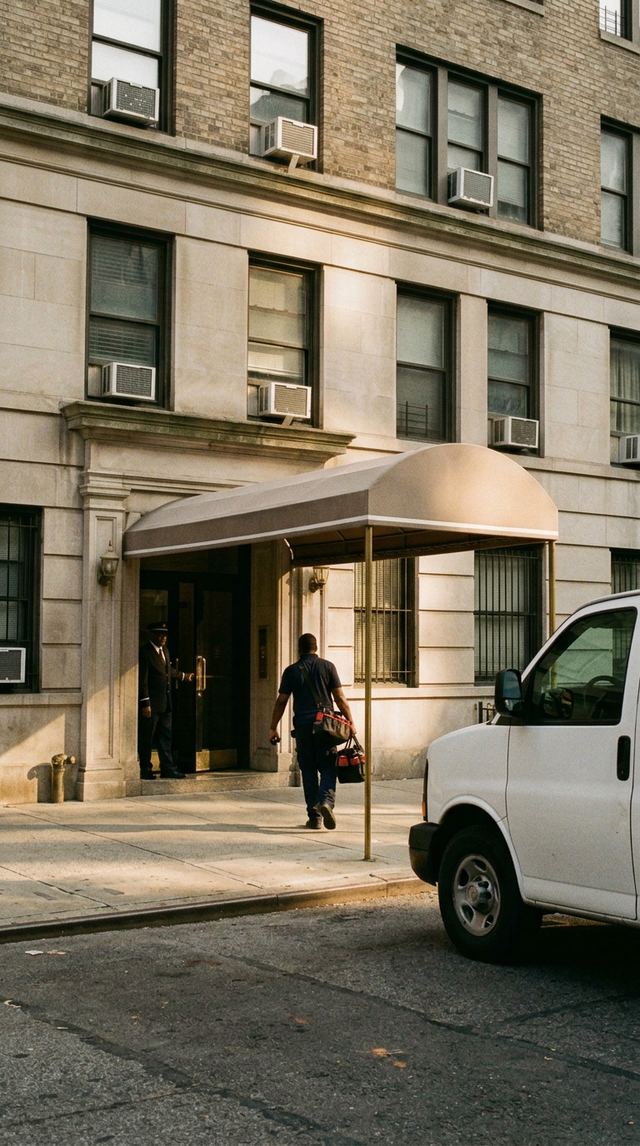
Manhattan has the lowest share of single-family housing in the city — under 2% of units, according to NYU Furman Center research on NYC's housing stock. Most Manhattan apartments sit inside prewar co-ops built between the 1900s and 1930s, postwar high-rise rentals, or newer luxury condo towers. Cooling was rarely part of the original building design — steam heat is centrally supplied and controlled by the building, but air conditioning has always been the resident's problem to solve, one apartment at a time.
That history is why PTAC units (packaged terminal air conditioners) — the through-wall boxes behind a metal grille under the living-room window — are the single most common cooling system in the borough. Most prewar buildings still run original or second-generation PTAC sleeves sized to the 42″ x 16″ opening that became the NYC standard decades ago, per industry guides on PTAC replacement in NYC. Ductless mini-splits are increasingly common in renovated apartments and brownstone-style buildings where a co-op board allows an interior wall unit, and window units persist in walk-ups and older rentals without sleeve openings. True central, ducted air is rare outside of the newest luxury towers.
Two things make Manhattan repair calls slower and pricier than the rest of the city. First, nearly every job in a co-op or condo touches a board approval process — alteration agreements, certificates of insurance naming the building, and freight elevator scheduling before a technician can even get equipment upstairs. Second, Manhattan's building density means many contractors serve luxury and commercial accounts first, so scheduling around a heat wave can mean a multi-day wait unless a company keeps dedicated residential crews. Seasonally, the borough's June–August demand spikes are the sharpest in the city, driven by both apartment towers and Midtown/Downtown commercial space competing for the same technicians.
Best companies serving Manhattan
These are the companies our editors most consistently see recommended for Manhattan's co-op boards, luxury buildings, and PTAC-heavy housing stock. Full writeups link to our individual reviews.
What breaks most in Manhattan apartments
PTAC sleeve units in prewar co-ops
The most frequent call our editors hear about: PTACs that run constantly without cooling, ice up, or leak onto the windowsill. On original 1940s–1970s sleeve installations, refrigerant leaks, worn fan motors, and failed compressors are common — basic repairs run $150–$300, while compressor or coil swaps run $400–$800, per PTAC repair pricing from Lion-Air Enterprises.
Board-approval delays
Not a mechanical failure, but the top complaint: getting a PTAC-to-mini-split conversion or a new sleeve opening approved. Alteration agreements and engineering drawings can take 4–8 weeks to clear before any work starts, per guidance on PTAC replacement in NYC co-ops.
Mini-splits in renovated apartments
Increasingly common in gut-renovated units and higher-end rentals. Failures tend to be refrigerant leaks or control-board issues rather than compressor failure, and service calls in Manhattan buildings often carry a 15–30% premium for after-hours access and doorman coordination.
Window units in older rentals
Found in walk-ups and pre-1960s rentals without sleeve openings, especially in neighborhoods like Washington Heights and Inwood. Capacitor and fan-motor failures are the usual culprits, and units over 8–10 years old are frequently not worth repairing.
What AC repair typically costs in Manhattan
Manhattan runs at or near the top of NYC's price range for AC repair, driven by co-op logistics, doorman buildings, and after-hours access windows rather than by the repairs themselves being more complex.
Diagnostic visit
$150–$280, often credited toward the repair if you proceed. Manhattan sits at the upper end of the citywide $150–$250 range because of building-access logistics, per industry pricing surveys.
PTAC repair
$150–$800 depending on the fault — capacitor or thermostat swaps at the low end, compressor or coil replacement at the high end. A full PTAC-for-PTAC unit swap runs $1,500–$3,500 installed.
Mini-split repair or conversion
Repairs commonly land $200–$800. A PTAC-to-mini-split conversion, including board approval and permit costs, runs $8,000–$12,000 per apartment; Manhattan co-ops and condos typically add 15–30% on top of citywide mini-split pricing for alteration agreements and access coordination.
Emergency / same-day service
Add $150–$400 to any of the above for after-hours or holiday dispatch. During a July heat wave, expect longer waits even at a premium, since commercial accounts (offices, restaurants) often get priority routing from the largest contractors.
These are typical ranges, not quotes — always get a written estimate before work begins, and confirm the technician's NYC Department of Consumer & Worker Protection Home Improvement Contractor license. See our full NYC AC repair cost guide for borough-by-borough comparisons.
Neighborhood-level notes
Upper East Side & Upper West Side
Dense with prewar co-ops along Park Avenue, Central Park West, and Riverside Drive. Expect the strictest board rules and the highest share of original PTAC sleeve installations — contractors who've worked these buildings before move faster through approvals.
Financial District & Battery Park City
Newer condo towers with more central and split-system cooling than uptown co-ops. Building management offices tend to be more responsive, but freight elevator booking still adds a day or two to scheduling.
Hell's Kitchen & Chelsea
A mix of prewar rentals, newer luxury rentals, and converted lofts. Sleeve PTACs and window units both common; several Manhattan-based dealers, including window/PTAC specialists, are headquartered in this stretch of Midtown West.
Washington Heights & Inwood
Older prewar rental stock with the highest share of window units left in the borough. Rent-stabilized buildings here are subject to new statewide cooling-service rules phasing in through 2030, which is starting to shift some units toward landlord-supplied PTACs.
Manhattan AC repair — frequently asked questions
Do I need co-op board approval to repair a PTAC?
A like-for-like PTAC swap in an existing sleeve is usually treated as routine maintenance and doesn't require board sign-off, but any conversion to a mini-split or new sleeve opening almost always does. Check your building's alteration agreement requirements before scheduling.
Why is AC repair more expensive in Manhattan than other boroughs?
The repairs themselves aren't more complex — the premium comes from doorman coordination, freight elevator scheduling, certificate-of-insurance paperwork, and contractors balancing residential calls against higher-margin commercial accounts.
Is my landlord required to fix a broken PTAC?
If cooling was part of your apartment when you moved in, most rent-stabilized tenants can file a DHCR complaint for decreased services if a landlord doesn't repair or properly replace it. See our guide to NYC landlord AC rules for specifics.
How long does a same-day PTAC repair take in Manhattan?
Once a technician is on-site, most straightforward PTAC repairs (capacitor, thermostat, drainage) take 1–3 hours. Compressor or coil work can take a full day, and buildings may require the work to happen during specific access windows.
Verified pros for this borough
These contractors are ranked in our 2026 NYC list and serve Manhattan. Verified 2026-08-13.
- Fusion Repair LLC (Manhattan HQ) — Google 4.9/210, EPA & NATE-certified, HVAC + appliance
- Figlia & Sons (Manhattan) — PTAC specialist, 65 years
- Arista Air (Queens LIC) — 76 years, commercial + luxury residential
- Airtronics (Midtown Manhattan) — 53 years, family-owned, Yelp 5.0/14
- Weather Makers (Midtown Manhattan) — Thumbtack 4.9/95+, BBB Accredited 2025