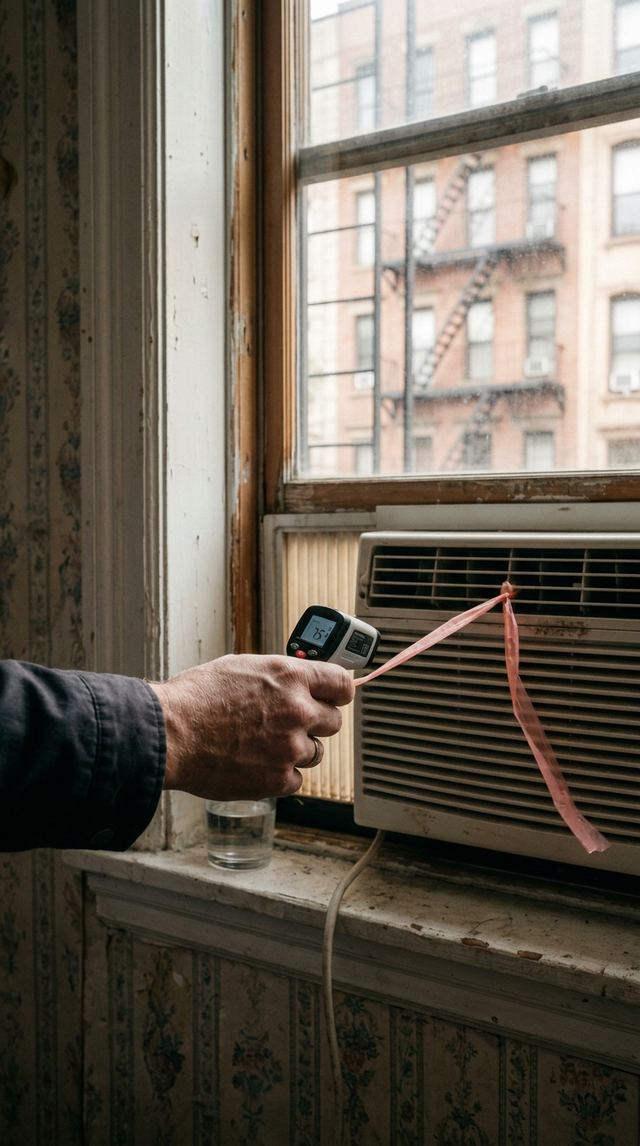
Fast decision tree: what is your AC actually doing?
Answer the question that matches your symptom — different failure modes need different first steps.
| Symptom | Most likely cause | Start at step |
|---|---|---|
| Fan runs, blows room-temperature air | Thermostat mode, batteries, or setting | Step 1 |
| Warm air, indoor unit runs, outdoor fan stopped | Tripped breaker, outdoor disconnect, capacitor | Step 3 |
| Cool air first 30 min, then warm; ice on copper line | Frozen evaporator coil (airflow or refrigerant) | Step 5 (frozen coil) |
| Warm air, oil stain on copper line or coil | Refrigerant leak | Step 8 |
| Warm air, clicking from outdoor unit, no start | Failed capacitor or contactor | Step 6 |
| Warm air, humming outdoor unit that never starts | Compressor lock-up or start components | Step 7 |
NYC-specific note: heat-wave days above 90°F push outdoor coil temperatures over 130°F. Capacitors and contactors fail earliest under that load; frozen coils are more common in shoulder seasons after a filter change is missed. Both patterns are documented on HVAC troubleshooting guides updated May 2026.
What you can safely check yourself
- Thermostat. Set to Cool, temperature at least 3°F below room temperature, fan on Auto. Confirm the mode display shows Cool, not Fan or Heat — Fan mode runs the indoor blower without calling for cooling and produces room-temperature air. If the LCD is flickering or dim, replace the batteries (typically two AA cells behind the cover, ~$4–$8). Cost when a technician handles this: $0–$8 in parts.
- Air filter. A filter darker than fresh cardboard is restricting airflow enough to freeze the evaporator coil. Replace with a MERV 8–11 filter matched to the return-grille size stamped on the frame. Let the system run 30 minutes with the thermostat set to Fan Only (not Cool) to melt any ice; only then switch back to Cool. Cost: $10–$25 in parts.
- Breaker and outdoor disconnect. Locate the double-pole breaker labelled AC or HVAC in the main panel. A tripped breaker sits in the middle position, not fully off. Flip it fully off, wait 30 seconds, then fully on. If it trips again immediately, stop — the outdoor unit has a short or a locked compressor. Do not attempt to reset a third time.
- Outdoor condenser power and airflow. Walk outside and confirm the outdoor unit is running — fan spinning, quiet hum from the compressor. If the fan is off and no sound is audible, check the outdoor disconnect (small grey box mounted on the wall next to the condenser). Clear at least 24 inches of clearance around the unit and hose down the outdoor coil with a garden hose from the inside out (never inside-out on the fins). A grass-clipping- or cottonwood-clogged coil raises head pressure and produces warm-air symptoms; cleaning it is free and takes 15 minutes.
Do not remove the outdoor disconnect cover, service-panel screws on the air handler, or any component with a capacitor. Capacitors hold a lethal charge even with the system unplugged and the breaker off.

Frozen evaporator coil: the warm-air symptom that hides ice
A frozen indoor coil is the single most common cause of "cool for the first 30 minutes, then warm" symptoms in NYC apartments. Airflow drops, the coil temperature falls below freezing, humidity condenses on the fins as ice, and eventually a solid ice block stops all cooling. Per Trane's residential troubleshooting guide, the top causes are:
- Restricted airflow from a dirty filter, closed supply registers, or a dirty blower wheel.
- Low refrigerant charge from a leak — lower pressure drops evaporating temperature below freezing.
- Failing indoor blower motor not moving rated CFM across the coil.
- Dirty evaporator coil restricting heat exchange.
- Undersized ductwork or blocked return in older NYC buildings converted to central air.
Diagnostic sequence: shut the system off at the thermostat (not Fan Only — that keeps the blower running against ice), leave power on the outdoor unit, and wait 3–4 hours for the ice to melt. Place towels or a shallow pan under the indoor unit to catch melt water. Then restart in Cool mode; if the coil freezes again within an hour, the cause is refrigerant or blower, both technician-level.
Requires a licensed technician (EPA Section 608)
Refrigerant work is federally regulated. Only technicians holding EPA Section 608 certification — Type I (small appliances, <5 lb charge), Type II (high-pressure), Type III (low-pressure), or Universal — may purchase, recover, or handle regulated refrigerants. As of January 2025, the maximum civil penalty for a Section 608 violation, including knowing venting, is $124,426 per day per violation. Unauthorised recharge on your own system carries the same legal exposure.
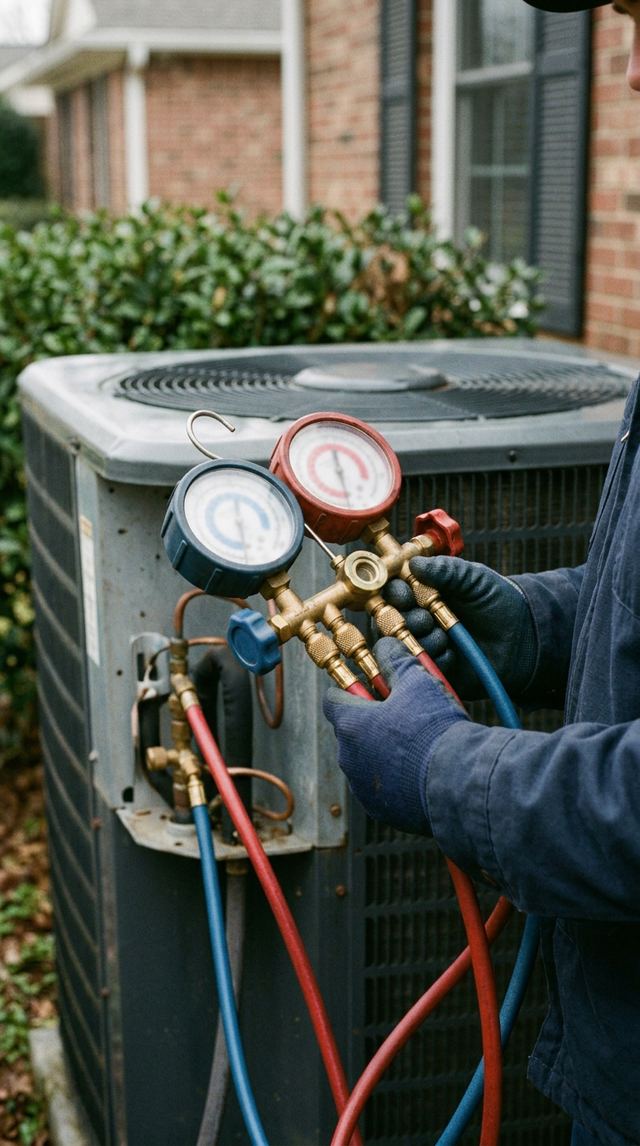
- Refrigerant level. Low refrigerant is the most common cause of persistent warm air on a system past its 5-year mark. Diagnosis requires manifold gauges on the service ports, a subcooling or superheat calculation appropriate to the metering device (TXV or fixed orifice), and a comparison against the manufacturer's charging chart. A recharge without a leak search is a $275–$650 temporary fix; refuse it.
- Run capacitor. A failed capacitor is the most common single-part failure in NYC summer heat waves. Symptom: outdoor fan hums but does not spin, or spins slowly. A technician tests capacitance with a multimeter (should read within ±6% of the printed µF value) and replaces if outside spec. Part cost ~$45; installed $150–$425.
- Compressor. If the outdoor fan runs, the capacitor tests good, and no cold air arrives, the compressor may be locked or the internal windings may have failed. Diagnostics require pressure gauges, a megohmmeter for winding insulation resistance, and amperage draw comparison. Compressor replacement runs $1,200–$2,400 on a residential split — always demand a repair-vs-replace analysis before authorising work on a system past year 10.
- Refrigerant piping. A visible oil stain on copper lines, service valves, or the outdoor coil indicates a refrigerant leak. Repair requires refrigerant recovery (Section 608 recovery machine and cylinder), brazing, evacuation to 500 microns or below, and recharge to manufacturer specification. All EPA-regulated. Nitrogen pressure-test and electronic leak-search line items must appear on any legitimate quote.
2026 refrigerant context for NYC repairs
Two regulatory shifts affect diagnostic decisions this year:
- AIM Act leak-rate threshold. As of January 2026, the American Innovation and Manufacturing Act lowered the leak-rate tracking threshold for HFC-containing appliances from 50 lb to 15 lb of refrigerant. Residential split systems typically hold 3–10 lb and stay outside reporting, but mixed-use NYC buildings with commercial-tonnage rooftop units now fall inside the tracking window. Ask the contractor for the leak-rate calculation if the system charge is over 15 lb.
- R-22 systems still in service. Pre-2015 NYC installations often used R-22, which stopped production in 2020. R-22 recharge alone can exceed $500 per pound. On leaking R-22 systems, replacement with an R-410A or R-32 unit is almost always the better financial decision. If the contractor confirms R-22, treat any refrigerant repair estimate as a replacement conversation.
- New equipment is A2L. New residential AC sold in the United States since January 2025 uses R-32 or R-454B (A2L class, mildly flammable). Any full replacement will be A2L; existing R-410A repairs continue with existing refrigerant stocks through 2027–2028.
When to escalate to emergency dispatch
Emergency service in NYC runs $130–$175/hr plus a $150–$250 trip charge on top of the standard invoice. Reserve for genuine safety and property risk:
- Water damage from a blocked condensate line (active drip through a ceiling or into a wall cavity).
- Burning smell or visible smoke from the indoor unit.
- Grinding, metallic clanging, or continuous humming from the outdoor unit.
- Repeated breaker trips within 10 minutes of restart.
- Refrigerant smell, dizziness, or headache in an enclosed space.
- Indoor temperature above 88°F during a heat wave with vulnerable occupants (medical needs, elderly, infants).
For everything else, book a next-business-day appointment and save the emergency premium.
Sources
- US EPA — Section 608 Technician Certification (2026 penalty schedule)
- Wikipedia — Section 608 categories and civil penalty reference
- Trane Residential — Frozen evaporator coil causes and diagnostics
- BTUsize — AC blowing warm air troubleshooting (reviewed May 2026)
- NYC Department of Buildings — HVAC permit and filing requirements (DOB NOW)