The three rules of thumb
NYC service technicians use three widely accepted rules of thumb — each a shortcut to the same underlying question of whether the remaining useful life justifies further spending.
- The $5,000 rule. Multiply the system’s age (in years) by the repair estimate ($). If the product exceeds $5,000, replacement usually wins. A 12-year-old unit facing a $500 repair scores 12 × $500 = $6,000 → replace. A 5-year-old unit facing an $800 repair scores 5 × $800 = $4,000 → repair.
- The 50% rule. If a single repair costs more than half of what a comparable new system would cost, replace. This is the strongest signal when the repair is a major component (compressor, evaporator coil).
- The age rule. Central AC and heat pumps typically last 10–15 years in NYC service. Past 12 years, treat any major repair as a replacement decision rather than a repair decision. Past 15, the math almost always favours replacement.
Repair usually wins when
- The unit is under 10 years old and has a solid service history.
- The fix is a single, identifiable failure — capacitor, contactor, fan motor, thermostat, drainage float switch.
- The repair cost is under 25–30% of a new system.
- The refrigerant is R-410A (still widely serviced) or R-454B (the 2025+ replacement) — not R-22.
- You’re selling within one to two years and a small repair buys enough runway.
Common repairs that almost always earn their cost back: capacitor swap ($150–$300), contactor swap ($150–$300), thermostat replacement ($150–$280), condensate line clearing ($120–$260), fan motor replacement ($300–$800).

Replace when two or more of these are true
- Age is over 12–15 years. Efficiency degrades, parts get harder to source.
- You’ve had three or more service calls in 24 months, or any single repair over $1,500.
- The system uses R-22 refrigerant and has a leak. R-22 production ended in 2020; remaining supply is $50–$150 per pound and a recharge easily reaches $1,000+.
- The compressor has failed. Compressor replacement on a residential unit is $1,500–$3,500 installed; outside of warranty this rarely beats replacement.
- Utility bills have climbed 25% or more with no change in usage, and cooling has become uneven.
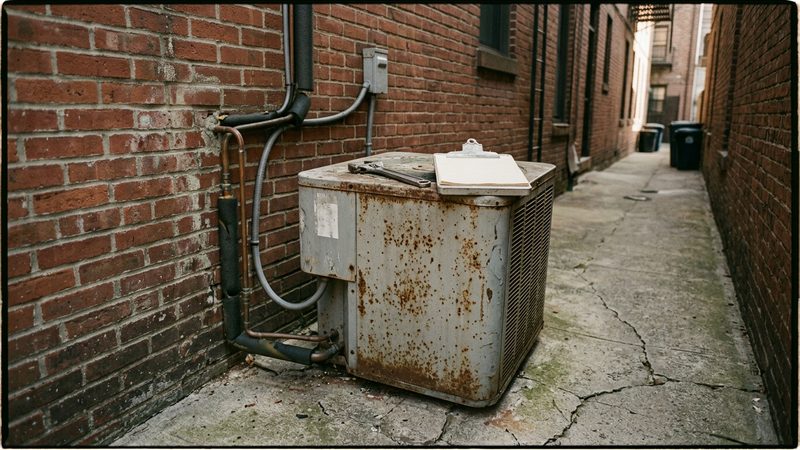
- You see visible rust, corrosion, or oil stains on the outdoor unit — classic end-of-life signals.
Quick-reference table
| Situation | Usually repair | Usually replace |
|---|---|---|
| System age | < 10 years | > 12–15 years |
| Repair cost vs new system | < 30% | > 50% |
| Refrigerant | R-410A or R-454B | R-22 with a leak |
| Repair frequency | First major issue | 3+ calls in 24 months |
| Utility bills | Stable | Rising with no usage change |
| Cooling coverage | Even, whole-home | Rooms that never reach setpoint |
| Compressor | Working | Failed or seizing |
Age × repair cost matrix
The $5,000 rule visualised — the highlighted cells are where the math tips toward replacement.
| System age | $300 repair | $600 repair | $1,500 repair |
|---|---|---|---|
| 5 years | Repair ($1,500) | Repair ($3,000) | Borderline ($7,500) |
| 10 years | Repair ($3,000) | Borderline ($6,000) | Replace ($15,000) |
| 15 years | Borderline ($4,500) | Replace ($9,000) | Replace ($22,500) |
| 20 years | Borderline ($6,000) | Replace ($12,000) | Replace ($30,000) |
The 2026 refrigerant context
R-22 has been phased out for years and is expensive to recharge; any R-22 system needing refrigerant work is almost always a replacement. Systems using R-410A remain fully serviceable in 2026, but 2025 marked the transition to lower-GWP refrigerants (primarily R-454B in the US). If you’re replacing, ask specifically about R-454B compatibility and future-refrigerant-friendly service parts. This is not a reason to replace a healthy R-410A system prematurely — but it is a reason to weigh replacement more seriously on any borderline decision.
NYC-specific factors that shift the math
- Building alteration agreements. Many co-ops and condos require pre-approval for a condenser swap, and some require a DOB permit if the new unit is larger. Bake this timeline (often 60–90 days) into any “replace now vs limp through summer” decision.
- Local Law 97. Multi-unit buildings face carbon caps starting in 2024 (with tighter limits in 2030). If your building is trending toward electrification, replacing a resistance-heat + AC combo with a heat pump can be strategically better than one more central-AC replacement.
- PTAC and through-wall. PTAC units in NYC apartments typically last 8–12 years. Replacement of a 10-year-old PTAC often costs less than a compressor rebuild on the same unit.
Before you decide, ask for
- The unit’s model number, serial number (the manufacture year is embedded in most serials), and refrigerant type — all from the data plate.
- A written diagnostic that specifies the failed component and the repair cost.
- A written replacement quote from the same contractor, so you can apply the $5,000 rule and the 50% rule with real numbers.
- A second opinion if the repair quote is over $1,500 or if replacement is being recommended on a system under 8 years old.
Sources
- US Department of Energy — Central air conditioning
- ENERGY STAR — Central air conditioners
- US EPA — Section 608 Technician Certification
- NYC Mayor’s Office of Climate & Environmental Justice — Local Law 97